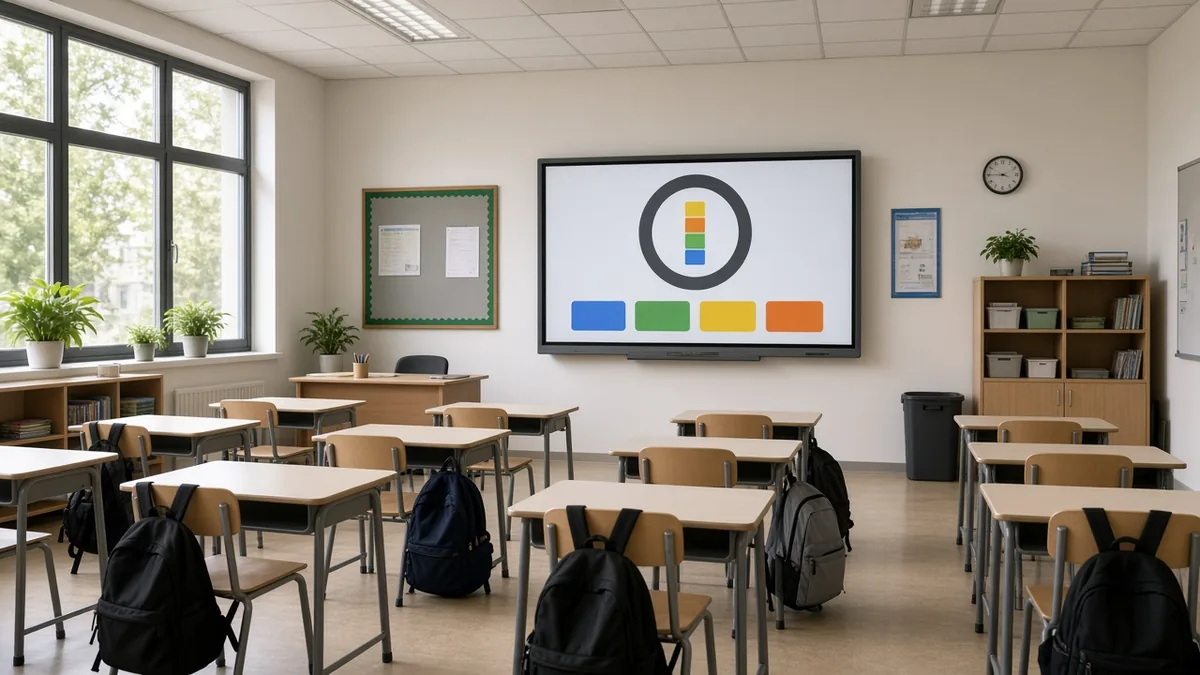
Middle school classroom management works best when it is predictable, respectful and quick. Students between about 11 and 14 want independence and fairness more than almost anything, and they notice instantly when a rule is applied to one student and not another. The strategies that hold up in grades 6 to 8 are the boring, consistent ones: the same entry routine every day, clear expectations that are visible on the screen, short lesson chunks, and quiet, private correction instead of public battles.
This guide covers 15 classroom management strategies for middle school, grouped by the moment of the lesson where they help most, plus a sample routine you can project. To put them into practice tomorrow, open a free classroom board with a timer and a noise meter side by side.
Why middle school needs its own approach
Strategies that work in elementary school, such as clip charts and class-wide prizes, often feel childish to a seventh grader. High school approaches that rely on self-direction can leave younger students drifting. Middle schoolers sit in between.
A few traits shape what works:
- Peer audience matters. A public reprimand turns into a performance. Private correction keeps the student's dignity and the lesson moving.
- Fairness is everything. Students accept firm rules if they believe the rules are applied evenly.
- Attention comes in short bursts. Long stretches of listening invite side conversations. Change the activity often.
- They want some control. Small, real choices reduce power struggles.
The strategies below are built around those four points.
Strategies for the start of class
1. Greet students at the door
Stand at the door for the first minute. A name and a quick "good to see you" lets you read the mood of the room before the bell, spot a student who is upset, and set the tone without saying a word about rules.
2. Use the same entry task every day
Put a short warm-up on the screen before students arrive: a question, a problem or a quick write. The task matters less than the habit. When students know they walk in, sit down and start, the first five minutes run themselves. Our list of classroom writing prompts has ready-made options.
3. Show the agenda
List three or four steps for the lesson on the board. Middle schoolers relax when they know what is coming and how long it will last. Keep it visible all period and check items off as you go.
4. Make expectations visible
Post the expected voice level and movement rule for each part of the lesson. Many schools use the CHAMPS framework for this; our guide to a CHAMPS classroom management screen shows how to display it. If you are still writing your rules, start with our classroom rules ideas.
Strategies during instruction
5. Teach in short chunks
Explain for a few minutes, then give students something to do: answer on a whiteboard, talk to a partner, solve one problem. Alternating input and action keeps attention up and gives restless students a legitimate reason to move or talk.
6. Use a visible timer for every task
"Work on this for a while" invites stalling. "You have six minutes" with a countdown on the screen does not. A classroom timer also stops the "how long do we have?" questions. Our classroom timer strategies post has more ideas.
7. Call on students fairly
Relying on volunteers lets the same five students carry the lesson. A random name picker keeps everyone ready and feels fair, because the screen chooses, not you. Give a short think time first so nobody is put on the spot.
8. Use proximity and non-verbal cues
Most minor behavior can be handled without stopping the lesson. Walk toward a chatty table while you keep talking. Tap a desk, make eye contact, or point to the expectation on the screen. Save words for when the quiet signals do not work.
9. Show the noise level, not just your frustration
Group work gets loud. Instead of repeated "shh," let students see the volume on a noise meter or a simple traffic light. It turns noise into feedback rather than a personal complaint. Our noise meter strategies explain how to introduce it to older students.
Strategies for group work and transitions
10. Assign groups and roles
Letting students choose groups every time can leave some students out and puts friends together who struggle to focus. Mix it up with random groups from the group maker, and give each member a role, such as reader, recorder, timekeeper or reporter. A clear seating plan helps too; see our seating chart ideas.
11. Practise transitions like a skill
Moving desks, collecting laptops and switching activities are where lessons fall apart. Teach the steps once, time a practice run, and show the time on the screen. Students usually get faster when they can see the clock. Our guide to classroom transitions with timers has short routines to rehearse.
12. Build in a movement break
A one- or two-minute stretch, a quick standing vote or a short game resets attention in a long block. Our no-prep brain breaks work for middle school when you pick the less childish options.
Strategies for behavior and relationships
13. Correct privately and briefly
When a student breaks a rule, keep the correction short, calm and quiet. State the expectation, give a choice if possible ("You can work here or at the side table"), and walk away. Arguing in front of the class rarely ends well for anyone.
14. Follow through every time
Consistency matters more than strictness. If you say there will be a consequence, follow through calmly, the same way for every student. Use your school's discipline policy for serious issues and involve families and support staff when a pattern continues.
15. Recognize what you want to see
Older students still respond to recognition, but they prefer it low-key: a quiet word, a positive note home, or team points rather than individual stickers. Our classroom reward ideas include options that suit grades 6 to 8, and schools using PBIS can link points to their PBIS screen.
Phones, laptops and other devices
Devices are one of the biggest management challenges in grades 6 to 8. Start with your school's policy, because consistency across classrooms matters more than any one teacher's system. Within that policy, a few habits help:
- Give devices a home. A phone pocket chart, a basket by the door or "face down, top corner of the desk" works better than repeated reminders.
- Signal device time on the screen. Show a laptop icon or a short note such as "Laptops open" and "Laptops closed" so students do not have to guess.
- Use a "screens at 45 degrees" check. During laptop work, ask students to tilt screens so you can see them as you walk the room.
- Plan offline backups. When the Wi-Fi drops, a paper version of the task stops a lesson from turning into free time.
Working with families and colleagues
Middle school students see several teachers a day, so shared expectations across a grade-level team make every classroom easier. Agree on common routines, such as how students enter, how they ask to leave the room and what happens when work is late. When students hear the same language in every class, they stop testing each teacher separately.
Families are partners too. A short positive message home early in the term makes later conversations about behavior far easier. When you do need to call about a problem, describe what happened, what you have tried and what you would like to see next, and ask what works at home. If a pattern continues, bring in your school counselor or administrator rather than handling it alone.
A sample routine you can project
Here is one way a 50-minute middle school period can look on a single board. Adjust the times to your schedule.
| Time | What students do | On the screen |
|---|---|---|
| 0–5 min | Enter, sit, start the warm-up | Entry task, timer, voice level 0 |
| 5–15 min | Mini-lesson with quick checks | Agenda, random name picker |
| 15–35 min | Partner or group task | Groups, roles, timer, noise meter |
| 35–40 min | Transition and movement break | Countdown timer |
| 40–47 min | Independent practice | Task steps, timer, voice level 1 |
| 47–50 min | Exit ticket and pack up | Exit ticket question |
The exit ticket gives you a quick read on who understood the lesson. Our exit ticket ideas have questions you can rotate, and the exit ticket tool puts one on the screen.
Common mistakes to avoid
- Too many rules. Five clear expectations beat fifteen that nobody remembers.
- Public power struggles. Move the conversation to the hallway or after class.
- Inconsistent follow-through. Students test boundaries to see if they are real.
- Long lectures. Break instruction into short pieces with something to do in between.
- Group consequences for individual behavior. Punishing the whole class for a few students damages trust quickly.
- Changing the routine every week. Predictability is what frees up attention for learning.
Putting it together
You do not need all 15 strategies at once. Start with three: a daily entry task, a visible timer for every activity, and private, calm correction. Once those feel automatic, add fair calling, assigned roles and practised transitions. Save the board layout as a template so every class period starts the same way. For an overview of the tools behind these strategies, see our guide to classroom management tools, and for ready-made board layouts by grade, visit MyClassScreen for middle school.
A daily warm-up is one of the easiest routines to build; try these bell ringers for middle school.