Classroom Screen Timer
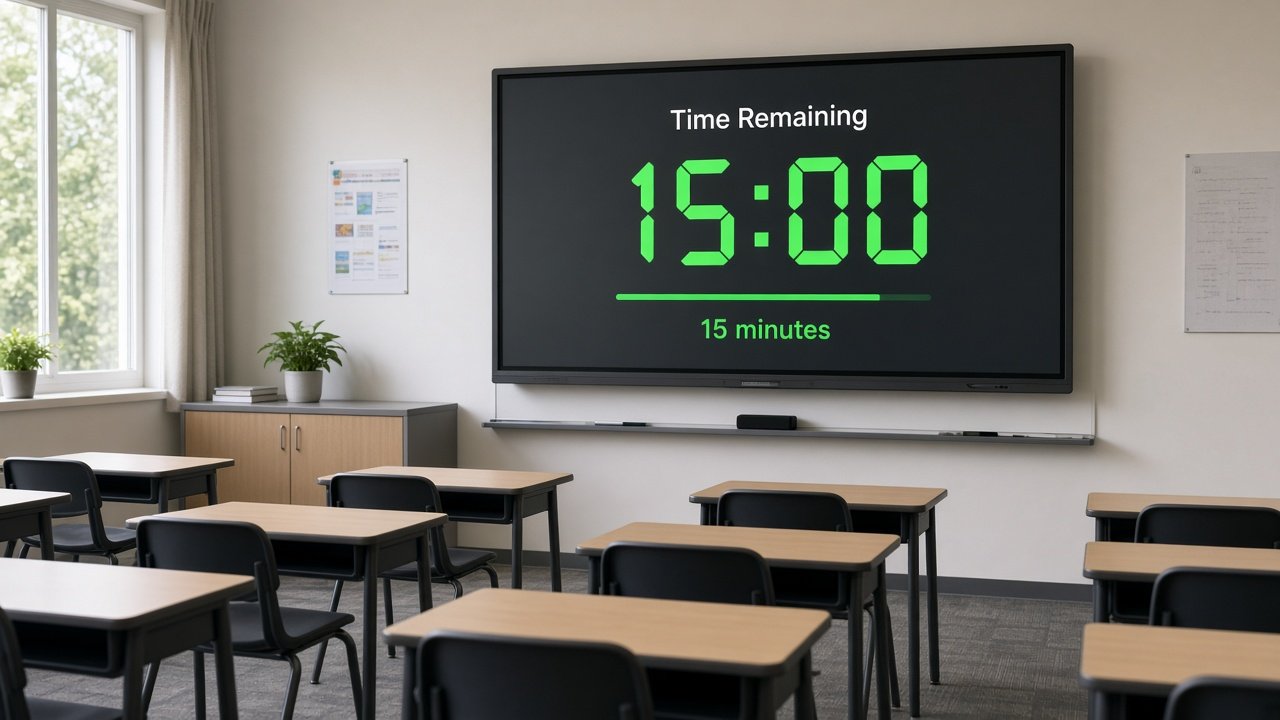
Countdown, visual bar, stopwatch, and clock on one projected timer. Set any duration, add a label, and let the board manage transitions.
Why a projected timer beats repeating yourself
You have probably said "two more minutes" six times during a single activity. Students tune it out. A classroom screen timer gives them something concrete to watch. The numbers are large enough to read from the back row. The progress bar shrinks as time runs down. When the display turns red, everyone knows the block is over — no argument, no "just one more sentence."
That matters during transitions especially. Third period ends, fourth period walks in, and you need notebooks out before the bell routine is done. A two-minute countdown on the board trains the habit faster than your voice alone. The timer becomes the neutral referee. You stay focused on teaching instead of policing the clock.
MyClassScreen's timer is built for projection, not phone-sized screens. You can label each countdown ("Silent reading," "Partner share," "Line up"), resize the widget, and run it beside a classroom clock or traffic light on the same board. Try the demo above, then open the full editor when you want to save your layout.
Visual timer
A visual timer is the same countdown with the shrinking bar as the main cue. Younger students and anyone who finds digits abstract watch the bar shrink instead of reading minutes. Resize the widget large, start a round number (5:00, 3:00), and keep the label visible. This is the same classroom screen timer — just framed for the bar, not the clock face.
Classroom stopwatch
Switch the widget to count up for fluency drills, lab timings, and “how long did that transition actually take?” Post the record, then challenge the next class. The stopwatch lives on this same page — no second tool to open.
Classroom clock
Need a large digital clock on the same board? Add the clock mode next to a countdown so students see both “what time it is” and “how much is left.” 12-hour and 24-hour both work on a projector.
Popular ways to use the timer
Transition Time
Give students two or three minutes to pack up one subject and get materials for the next. The timer ends the negotiation.
Timed Assessments
Set a visible countdown for quizzes and exit tickets so students pace themselves without you calling out every five minutes.
Brain Breaks
Five-minute movement or breathing breaks between long blocks. When the timer hits zero, everyone knows it is time to settle.
Group Work
Allocate fifteen or twenty minutes for collaborative tasks. Groups check the board instead of asking how much time is left.
Timer tips by grade band
The same widget works in kindergarten and AP Chemistry, but how you frame it changes. Shorter, labeled timers work best for younger students. Older students respond well when they know the timer is fair and consistent period to period.
Elementary (K–5)
Keep durations short and predictable. A three-minute "clean-up countdown" after centers becomes a classroom ritual by October. Pair the timer with a visual cue: when it hits zero, hands on desks, eyes on you. For K–2, use round numbers (5:00, 3:00, 2:00) and say the label out loud as you start it. First graders who cannot yet read clocks still understand a shrinking bar.
Middle school (6–8)
Middle schoolers push boundaries, but they also respect clear structures. Use the timer for station rotations, quick writes, and "pack up without talking" challenges. A stopwatch works well here too — time how long a transition actually takes, post the record on the board, and challenge the next class to beat it. They love beating a number more than obeying a lecture.
High school (9–12)
Use countdowns for AP-style sections, Socratic seminars, and lab procedures where pacing matters. Label timers honestly: "15 minutes — draft paragraph" sets a different tone than an unlabeled clock. During assessments, a visible timer reduces "how much time do we have?" whispering across the room. Title I and intervention blocks often run on tight schedules — a labeled timer on the projector keeps pull-out groups aligned with homeroom return times without walkie-talkie calls. Save a board preset with your usual block lengths so Monday morning setup takes thirty seconds.
Common timer mistakes (and easy fixes)
Setting a timer without a label confuses students. They see numbers but do not know whether to write, read, or line up. Always name the block: "Draft time," "Gallery walk," "Pack up." Another mistake is going too long on the first try. Start with a shorter countdown than you think you need; you can add time, but taking time away mid-activity feels unfair and starts an argument.
Font size matters on projectors. If students in the back row squint, drag the widget larger before you start. Test from the rear corner once during prep — thirty seconds that saves ten interruptions. Finally, do not hide the timer behind other windows. Pin your board tab and use full-screen during timed blocks so the countdown stays the focal point.
Pair the timer with your morning board
Most teachers do not use the timer in isolation. A typical board might show today's warm-up in the text widget, a five-minute countdown for entry tasks, and a random name picker for discussion. When the entry timer ends, you pick a name and start instruction — same flow every day. Read our timer strategies guide for more routines that actually stick.
Special education and inclusion teachers often duplicate timers on the same board: one for the whole class and a shorter personal countdown for a student who needs extra warning before transitions. You can also run a silent reading timer every day at the same duration so the routine becomes muscle memory by October. Consistency beats novelty for classroom pacing.
Privacy note: The timer runs entirely in your browser session. Students do not log in, and nothing requires them to use personal devices. If you save a board with a free teacher account, your layouts are stored for your convenience — not shared with students. See our Privacy Policy for details.
How to set up the classroom timer
- 1 Go to the MyClassScreen board editor and add the Timer widget from the widget panel.
- 2 Open settings and set minutes and seconds. Add a label so students know what they are timing.
- 3 Drag the corner handles to resize the timer until it is readable from the back of the room.
- 4 Click Start and press full-screen on your browser or display software.
- 5 When time is up, reset or adjust the duration for the next activity. Save the board if you want the same setup tomorrow.
Need keyboard shortcuts or repeat mode? See the timer widget help page.
Transitions without the verbal countdown
Most teachers already count down out loud: “Three minutes… two minutes… one minute…” Students hear it, then ask again thirty seconds later. A projected timer removes that loop. You start it once, raise your voice only if someone is off-task, and let the numbers do the reminding.
Try a two-minute pack-up timer between subjects, a ten-minute independent reading block, and a five-minute brain break. Keep a noise meter nearby for talkative transitions. If you teach on an interactive panel, see the timer widget help for full-screen and browser tips.
For younger students or anyone who struggles with abstract numbers, the visual timer framing may land better — same tool family, more emphasis on the shrinking bar than the digits.
This timer is one piece of your classroom screen
Combine the timer with a noise meter, name picker, and traffic light on one free board. Project it full-screen and run your period from a single tab.
Build your free classroom screen