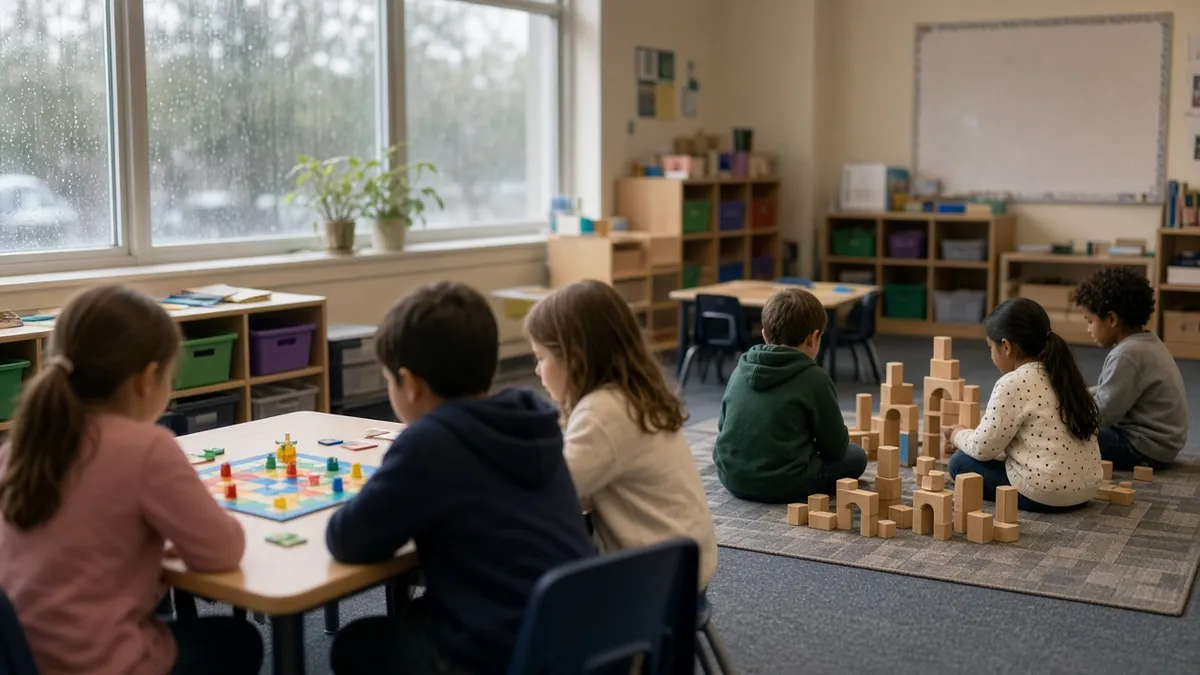
Good indoor recess ideas turn a rainy or freezing day from chaos into a real break. The trick is to plan it before the weather turns: pick a few active games that fit between desks, set up calm stations for kids who need quiet, and run the whole thing with a visible timer and one simple rule list. Below are 15 tested ideas, a station rotation you can reuse all winter, and a ready board layout for your classroom screen.
Recess matters even when it moves inside. The CDC and SHAPE America recommend at least 20 minutes of recess a day, and their recess strategies guide encourages schools to plan indoor spaces and activities for bad-weather days, rather than replacing recess with seat work.
Set up indoor recess before the first rainy day
A few minutes of setup in November saves a lot of noise in January.
- Agree on the space. Mark which parts of the room are for movement and which are for quiet play. Push desks into a "U" or clusters to clear a lane.
- Make an indoor recess bin. Board games, decks of cards, dominoes, building blocks, drawing paper, jump ropes for counting games, a soft ball, and a few puzzles.
- Teach three rules once. For example: walk, don't run; voices at table level; clean up when the timer ends.
- Pick a signal. A chime, a raised hand or a countdown on the board tells everyone to freeze and listen.
- Put it on the board. Open the classroom timer and a short text list of today's choices so students can start without asking you.
Active indoor recess games
Kids need to move, especially after a morning of sitting. These games work in a normal classroom with desks pushed back.
1. Four corners
Number the corners of the room. One student closes their eyes and counts down while everyone tiptoes to a corner, then calls a number. That corner sits out. For a fair caller, roll the dice roller on the board instead.
2. Freeze dance
Play music and stop it at random. Anyone still moving sits out or does five jumping jacks to get back in. Add rules like "freeze like a snowman."
3. Silent ball
Students stand in a loose circle and toss a soft ball without talking. A bad throw, a drop or a sound means you sit down. It is surprisingly calming.
4. Simon says, with a twist
Use exercise moves: "Simon says do three squats," "Simon says touch your toes." Let a student lead each round.
5. Hallway or classroom obstacle course
Use tape lines to hop along, a desk to crawl under (safely), and a spot to do ten jumping jacks. Time each runner with the timer and post personal bests.
6. Exercise dice
Roll two dice: one picks the move (1 = jumping jacks, 2 = squats, 3 = arm circles, and so on) and one picks the count. The dice roller on the board means everyone can see the result.
Calm and creative stations
Not every child wants to move. Offer quiet choices too.
7. Board game and card table
Classic games such as checkers, Connect Four and Uno teach turn-taking. Rotate the box each week so it stays fresh.
8. Building station
Blocks, LEGO bricks, or cups and index cards. Give a challenge on the board: "Build the tallest tower that holds a book."
9. Drawing board and doodle prompts
Project the drawing board and let students take turns drawing while others guess. At desks, offer a prompt such as "draw a snow day from a squirrel's point of view."
10. Puzzle corner
A large jigsaw puzzle on a back table becomes a weeks-long class project. Kids add a few pieces every indoor recess.
11. Reading nook
Pillows, a basket of comics and picture books, and a "no talking" sign. Some students recharge best here.
Whole-class indoor recess games on the screen
When the whole room needs a shared activity, use the projector.
12. Pictionary or charades
Students take turns acting or drawing a word. Use the random name picker to choose who goes next so the same hands do not always win.
13. Team trivia with a scoreboard
Split the class into teams with the group maker and keep score on the scoreboard. For ready-made projected games such as Jeopardy, Hangman and Wordle-style puzzles, see our classroom games guide.
14. Would you rather
Show two choices on the board ("Would you rather have a snow day or a pool day?"). Students move to one side of the room to vote, which adds movement.
15. Guided movement videos
Short follow-along movement or yoga videos are popular for indoor days. Preview each one first and keep the volume low enough to stay in your space.
A simple station rotation
Free choice works well with small classes. With 25 students in one room, a rotation keeps it calm.
| Station | Activity | Group size |
|---|---|---|
| A | Active game zone (four corners, freeze dance) | 6 to 8 |
| B | Board games and cards | 4 to 6 |
| C | Building challenge | 4 to 6 |
| D | Drawing, puzzles or reading nook | 4 to 6 |
- Use the group maker to split the class into four groups.
- Set the timer for 6 or 7 minutes per station, depending on the length of your recess.
- When the timer ends, groups clean up and rotate clockwise.
- Save the last two minutes for a whole-class cleanup.
Over a week, every student tries every station. If your school gives you 20 minutes, three rotations of six minutes plus cleanup fit easily.
Keep the noise down
Indoor recess is meant to be fun, so expect some noise. To keep it in a healthy range:
- Show the noise meter on the board so students can see their volume. Our noise meter strategies explain how to set a fair threshold.
- Use the traffic light as a quick signal: green for normal play, yellow for "bring it down," red for freeze.
- Move the loudest game to the hallway or a shared space if your school allows it.
Indoor recess ideas by grade
Age changes what works. A quick guide:
- Kindergarten and first grade: short, simple games with clear movement, such as freeze dance, Simon says and follow-along movement songs. Keep stations to two or three choices so little ones are not overwhelmed, and show a picture of each choice on the board.
- Second and third grade: four corners, exercise dice and building challenges work well. Students this age love a "class record," so post the tallest tower or the fastest obstacle course time on the board.
- Fourth and fifth grade: older students enjoy strategy and team games. Try team trivia with a scoreboard, charades and longer board games such as checkers tournaments that continue across several indoor days. Let students design and lead their own games; it builds ownership and cuts down on complaints.
Whatever the age, give students a real choice. Recess is a break, and kids recharge in different ways: some need to move, some need to build, and some need ten quiet minutes with a book.
Make it easy for subs and other teachers
Indoor recess often lands on days when you are out or on duty elsewhere. Keep a one-page plan in your sub folder: the rules, the signal, the station list and where the bin lives. Save the board layout so anyone can open it and press start.
A ready board layout for indoor recess
Here is a layout that works on any classroom screen:
- Top left: a timer counting down the current station or the whole recess.
- Top right: the traffic light or noise meter.
- Center: a short text list of today's choices or the station chart.
- Bottom: the group list from the group maker.
Save it as an "Indoor recess" board so you can open it in seconds when the rain starts.
When indoor recess becomes a brain break
Sometimes the weather only allows a few minutes of movement, or recess is cut short. In that case, pick one or two ideas from our no-prep brain breaks on screen, which are designed for one to three minutes. For holiday-themed days in December, our winter holiday classroom activities offers inclusive ideas you can mix in.
More December ideas: winter break countdown ideas for the classroom.