By David · Founder & Editor, MyClassScreen
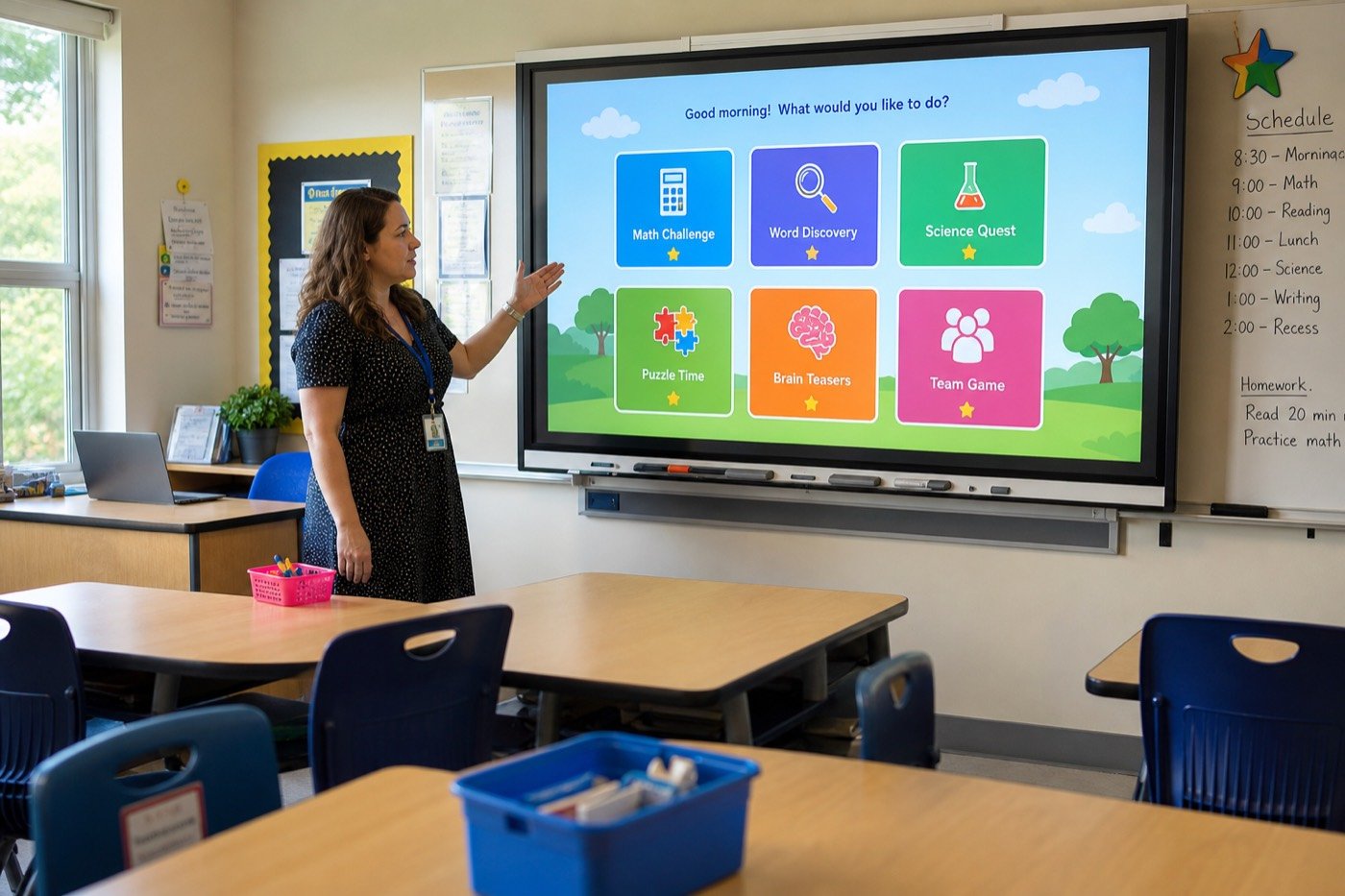
The classroom games that survive a real period are the ones already on the projector when you need them. Not a tab you hunt for. Not thirty Chromebooks in a login queue. A grid, a gallows, or a five-letter puzzle the whole room can see — teacher at the panel, class talking to the board.
I am picky about this because “classroom games online” is a search that dumps you into two different internets. One is unblocked-games culture: students on devices, you hoping the filter holds. The other is class games no student login: you project, they think, you click. MyClassScreen is the second internet. Jeopardy, Hangman, and Classroom Wordle live on the same board as your timer.
This is how I would actually run those three, plus the surrounding online review games that are fun without becoming the whole curriculum. Open https://app.myclassscreen.org/board when you want to try it, browse templates if you want a layout already assembled, and use the widgets list when you need the catalog instead of a pep talk.
Why projected classroom games beat another student app
Student-device games have a place. They are not a warm-up. Warm-ups die in “I forgot my password,” “my battery is at 4%,” and “I’m on the wrong link.” A projected game has one login: yours, and often not even that. The class looks up. You start.
Visibility is also the pedagogy. Fun review games work when the clue is shared. If half the room is on question 3 and half is still loading, you are not reviewing. You are managing devices. A Jeopardy classroom grid on the board keeps the conversation in one place. Wrong answers are public enough to correct, not public enough to be a gotcha if you run it kindly.
Brain breaks can stay on the same screen as the agenda. A random games website trains students to treat the projector as TV. A Hangman widget next to a timer trains them to treat it as the day’s tools.
Jeopardy classroom — the review game teachers actually mean
When a colleague says they need Jeopardy classroom review, they rarely mean a licensed TV set. They mean categories, point values, a clue, a pause, a reveal. They mean teams that groan in a useful way. They mean Friday without a packet.
The version that fails is the 40-slide PowerPoint you built in 2019 and are afraid to open. One wrong edit and the hyperlinks die. The version that lasts is a widget: a category grid you can change this week. MyClassScreen’s Jeopardy tool is that grid — click a clue, discuss, reveal. Pair it with the scoreboard if teams help your room. Skip the scoreboard if points turn the review into a riot.
Write clues from what you taught. Students can smell a scavenged deck. Jeopardy is retrieval practice wearing a game show jacket. If the clues are fluff, the jacket is empty. Teams confer before they shout; you pick the speaker; a short timer per clue so debate cannot eat eight minutes. Do not let the loudest student become the only contestant.
Stop while they still want one more clue. Leftover minutes can be a Wordle or a hangman word from the same unit.
Classroom Hangman — spelling with a clock
Classroom Hangman is easy to do badly. A random word, a long drawing, ten minutes of guessing C. That is a stall. The useful version is a secret word from this week’s list — a science term, a history name, a vocabulary word you actually expect them to spell.
Project Hangman, set the word before class or in a two-second pause with the screen muted, and take letter guesses from the room. I like using a name picker so it is not always the same volunteers. You can also take table guesses in order. The widget is the board state. You are still the teacher of the word.
Keep it short. One word as a bell-ringer. Two if they are fast. If you need more literacy, switch to Wordle or a word scramble instead of hanging a second stick figure. Hangman has a tone problem for some schools and some students; if your building has asked you not to use the gallows visual, do not fight the policy for a widget. Use scramble, spelling bee, or Wordle. The goal is letters on a board, not a specific cartoon.
After the word is revealed, spend thirty seconds on meaning, not on celebrating the drawing. That is what makes hangman a classroom game instead of a time-filler you would be embarrassed to show on an observation.
Classroom Wordle — one puzzle, thirty brains
Wordle already taught the country how to argue about a five-letter word. Classroom Wordle borrows the green and yellow feedback and puts you in charge of the secret. That is the whole upgrade. The New York Times puzzle is fine for your commute. It is a poor vocabulary list.
Set a 5-letter word that matches the week — a content word if it fits, a high-frequency word if you teach younger students, a pattern word if you are in phonics. Project Classroom Wordle. Take class guesses. Talk about why a letter is yellow. That talk is the lesson. The widget is the scoreboard for thinking.
Do not let phones out “so they can play along.” Then you have thirty private Wordles and no class. Class games with no student login means the puzzle is public. Guessing strategies become shareable. Quiet students can still hold up a whiteboard. You can collect those without opening an LMS.
One puzzle is enough for a warm-up. If they solve it in two guesses, you picked too easy a word or someone peeked. Pick better tomorrow. I will not pretend there is a research-backed number of Wordles per week. There is a teacher-backed limit: stop before it steals the reading block.
Other online review games on the same board
Jeopardy, Hangman, and Wordle are the search magnets. They are not the whole drawer. Trivia with a reveal, a classroom quiz, bingo, word scramble, and a scoreboard cover the days when a grid would be overkill. The classroom games hub lists them in one place so you are not collecting random bookmarks.
Brain-break games (Snake, Tetris, Connect Four) are legitimate for indoor recess and the last four minutes. They are not review. If you label Tetris as an “online review game,” students learn that words do not mean things. Use a timer. When it ends, the break ends. The same board that ran Jeopardy can run a one-minute break without opening a new universe of unblocked sites.
Dice, flashcards, and a wheel spinner sit in the overlap between game and tool. A wheel that picks a review category is a game move. A wheel that picks who answers is a name picker in costume. Either is fine. Just know which job you hired it for.
Review block
Jeopardy or trivia + scoreboard + timer. Clues from this unit only. Stop while they still want one more.
Literacy warm-up
Wordle or Hangman + a posted word list. Thirty seconds of meaning after the solve. Phones down.
Brain break
One timed arcade-style widget. Not a portal. When the timer hits zero, the game is over even if someone was “about to win.”
Templates and widgets — stop rebuilding the board
A classroom game you rebuild from a blank screen every Friday will lose to a worksheet. Save a layout. Use a template when the shape of the period is predictable: warm-up, review, break. The templates library is product layouts you can launch, not a pile of unnamed teacher PDFs. Open one, swap the game widget, keep the timer.
Widgets are how you customize without leaving the board. The features / widgets page and the in-app toolbar are the same idea: add Jeopardy, add a timer, add a scoreboard, project. You can start from app.myclassscreen.org/board with no student accounts. Sign up later only if you want the layout waiting tomorrow.
If you already have a morning-meeting template, do not make a second “games only” identity unless the kids need the visual reset. Many rooms can keep the agenda up and grow a game widget for ten minutes. Fewer widgets is faster than a themed board you never open.
A simple way to run a games block
- Open the saved board or a template before the bell.
- Set the timer for the game, not “until they get bored.”
- State the academic target in one sentence (“We are retrieving unit vocabulary,” not “We’re playing”).
- Run Jeopardy, Hangman, or Wordle — one main game, not three stacked until the clock dies.
- Close with the reveal or the solved puzzle, then go back to the agenda widget you already had.
That last step matters. Classroom games that never return to the agenda teach students that the board is recess. Classroom games that sit inside the board teach students that play can still be school.
What to skip
Skip sites built for students to browse games. Skip anything that needs a class code and thirty emails for Hangman. Skip licensed-looking Jeopardy downloads you cannot edit. Skip stacking so many widgets the clue is the size of a postage stamp.
Skip the habit of promising “fun Friday” and then spending Thursday night building a fragile deck. A widget you can update in two minutes is how fun Friday still happens in May.
The bottom line
Classroom games belong on a projected board when the class can see the same puzzle and nobody has to log in. Jeopardy carries review. Hangman carries a single important word. Wordle carries a shared reasoning talk. Templates and widgets keep you from rebuilding the stage.
Open app.myclassscreen.org/board, add one game next to a timer, and run it once this week. If the login queue was the thing you hated about “classroom games online,” this is the other path.
Play Jeopardy, Hangman, and Wordle on a free board
Teacher-projected classroom games — no student logins. Start from templates or add widgets live.
Open free classroom screen