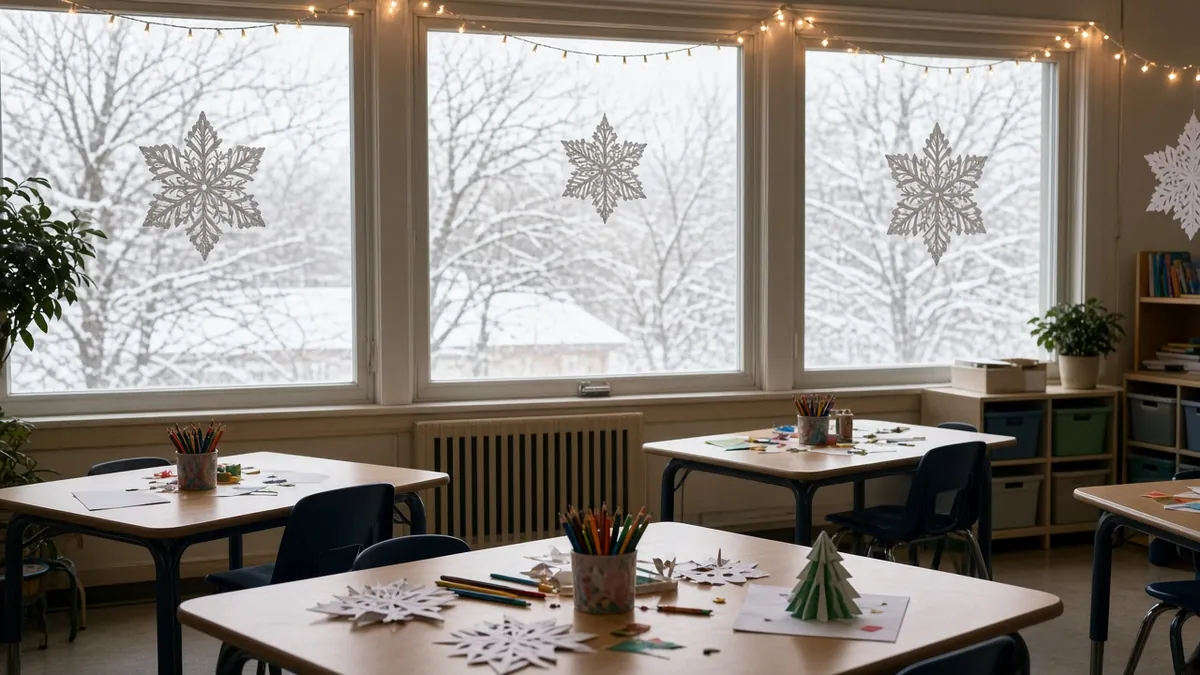
Winter holiday classroom activities help December feel festive without leaving anyone out. Planning the last two weeks? Try a winter break countdown routine. Classrooms often include students who celebrate Christmas, Hanukkah, Kwanzaa, Las Posadas, the winter solstice, or no December holiday at all. The ideas below focus on shared themes like light, kindness, winter weather and new beginnings, and each one runs on a free classroom screen with widgets you already know. Most need less than five minutes of setup.
Every idea works on MyClassScreen, our free board with timers, name pickers, noise meters and templates. No account is needed for you or your students.
Key December dates for 2026
Knowing the calendar helps you plan without clashing with family celebrations.
| Date | Observance |
|---|---|
| Friday, December 4 to Saturday, December 12 | Hanukkah (begins at sundown on December 4) |
| Sunday, December 13 | St. Lucia Day |
| Wednesday, December 16 to Thursday, December 24 | Las Posadas |
| Monday, December 21 | Winter solstice, the shortest day in the Northern Hemisphere |
| Friday, December 25 | Christmas Day |
| Saturday, December 26 to Friday, January 1 | Kwanzaa |
| Thursday, December 31 | New Year's Eve |
Many schools break before Christmas, so your last classroom days may fall in the week of December 14 or December 21. Check your district calendar.
Computer Science Education Week falls in early December; here is a ready Hour of AI plan.
Ground rules for inclusive holiday activities
Before the ideas, a few principles that keep December fun for every student:
- Teach about, do not celebrate for. Learning how families around the world mark winter is great. Asking students to perform religious practices is not.
- Make sharing optional. Invite students to share family traditions, but never require it.
- Include "no holiday" families. Winter themes like snow, light and kindness work for everyone.
- Avoid assuming gifts. Some families do not exchange gifts, and some cannot afford them. Focus on experiences and kindness instead.
- Check your school policy. Some districts have specific guidance on holiday activities.
Countdown and calendar activities
1. Winter break countdown
Put a large countdown on the board to the last day before break. Pair it with a daily one-sentence goal, such as "finish your book chapter" or "help a classmate today." Students love watching the number drop, and it gives you a calm routine for the busiest month of the year.
2. Solstice light count
From December 1 to December 21, display the day's sunrise and sunset times for your town in a text widget. Students subtract to find the hours of daylight and track the shrinking total on a class chart. On the solstice, celebrate the turn: from December 22, the days get longer again. Timeanddate's seasons calendar lists the exact solstice time.
3. Holidays-around-the-world calendar
Show the date table above on screen and add one short fact each morning. Keep each fact neutral and accurate: what the holiday celebrates, where it is observed, and one food or symbol. A random name picker can choose the student who reads the fact aloud.
Light-themed activities
Light is a common thread across many December traditions, which makes it a natural inclusive theme.
4. Lights of the world slideshow
Build a simple multi-screen board: candles of a Hanukkah menorah, the seven candles of a Kwanzaa kinara, St. Lucia's crown of candles, luminaria for Las Posadas, and city lights for New Year. Use one screen per tradition with a short caption. Students guess the tradition before you reveal it.
5. Shadow science
Use a flashlight and paper cutouts to explore how the angle of light changes shadows, then connect it to why winter days are shorter. Set a five-minute timer for each station.
6. Light a kindness candle
Draw a paper candle for each act of kindness the class completes. Display the count on the board. When the class reaches a goal, celebrate with an extra recess or a read-aloud.
Winter weather activities
7. Snowflake symmetry
Students fold and cut paper snowflakes, then check for six-fold symmetry. Real snowflakes have six sides because of how water molecules bond as they freeze. Display a timer for cutting and a work-symbol widget showing "quiet work."
8. Weather watch
Each morning, a student reads the forecast and updates a weather widget or text box with the temperature and conditions. Older students can graph highs and lows across December.
9. Winter word sprint
Put a winter word, such as "snowstorm" or "hibernation," on the screen and set a two-minute timer. Students write as many smaller words as they can from its letters. It works for spelling practice and as an early-finisher task.
10. Hibernation reading corner
Turn reading time into a "hibernation" with dim lights, a calm background and a quiet noise meter. Students curl up with a book while the timer counts down.
Brain breaks for the last weeks of December
Energy runs high in December. Short, structured breaks help. Our full list of no-prep brain breaks on screen includes more.
11. Snowball toss review
Students write a review question on scrap paper, crumple it into a "snowball" and toss it into a basket when the timer starts. Each student picks one up and answers it.
12. Freeze dance, winter edition
Play music and use the traffic-light widget: green means dance, red means freeze like an icicle. Thirty seconds is plenty.
13. Winter would-you-rather
Show two options on the board, such as "build a snowman or go sledding?" Students move to one side of the room. A random name picker chooses who explains their choice.
14. Two-minute stretch
Display a timer and a short stretch sequence: reach for the snowflakes, shake off the snow, melt into the floor.
Kindness and community activities
15. Kindness chain
Each link of a paper chain is one kind act. Hang it across the room and count links each Friday. Our World Kindness Day activities post has more kindness prompts.
16. Thank-you cards for school staff
Students write cards for custodians, cafeteria staff, bus drivers and office staff. Put sentence starters on the screen for younger students.
17. Class donation drive
If your school runs a coat, book or food drive, show the total on the board with a simple progress bar. Keep it optional and avoid singling out who gives.
New-beginnings activities
18. Year-in-review wall
Each student writes one favorite memory from the year on a sticky note. Display a few on screen each day with a random picker.
19. Goals for the new year
Before break, students write one goal for January. Seal them in envelopes and open them on the first day back. It is a simple way to connect December to the new term.
20. Time capsule
Older students can create a short time capsule: their favorite song, book, food and one prediction for next year. Open it at the end of the school year.
Picking activities by grade band
- Kindergarten to grade 2: snowflake symmetry, freeze dance, kindness chain and the winter break countdown. Keep each activity under 15 minutes and use picture cues on the screen.
- Grades 3 to 5: the solstice light count, winter word sprint, holidays-around-the-world facts and thank-you cards. These mix math, writing and social studies.
- Grades 6 to 8: the daylight graph, time capsule, weather data and a research mini-project on one winter tradition, presented in two minutes with a visible timer.
Mixing one active idea, one quiet idea and one community idea each day keeps the week balanced.
Setting up your December board in five minutes
- Open a template or a blank board.
- Add a countdown timer to the last day before break.
- Add a text widget for the "fact of the day" and a random name picker.
- Choose a winter background or upload a photo of your own snowy schoolyard.
- Save the board so it is ready every morning. Boards save in your browser, so use the same classroom computer each day.
Our guide to the morning meeting screen template shows a ready layout you can adapt.
Tips for a calm December
December is exciting and exhausting. A few habits help:
- Keep routines. Students feel safer when the schedule stays predictable, even in a festive week.
- Use visual timers. A visible countdown reduces "how long until…?" questions.
- Plan quiet moments. Pair every high-energy activity with a calm one.
- Communicate with families. Share your December plans in a newsletter so families know what to expect and can share traditions if they want to.
- Cold weather means more indoor days, so keep a list of indoor recess games ready.
After the holidays, switch to January classroom activities that welcome students back.