The week before, try these nonpartisan Election Day classroom activities.
For the rest of November, plan Native American Heritage Month activities on the same board. Two days later, World Kindness Day on 13 November is a good follow-up.
These Veterans Day classroom activities are built for one classroom screen and very little prep. Veterans Day falls on Wednesday, 11 November 2026, a school day for many students. The ideas below help you teach what the day means, thank veterans in your community and keep the tone respectful, using free widgets from MyClassScreen that you can open in seconds.
What Veterans Day is (and is not)
Before any activity, make sure students know what they are marking. The U.S. Department of Veterans Affairs explains the difference simply: Memorial Day honors service members who died in service, while Veterans Day thanks and honors everyone who served honorably, especially living veterans. Many children mix the two up, so a one-minute comparison at the start of class prevents awkward moments with a visiting veteran.
Veterans Day history for kids in five minutes
Put these five dates on the screen with the text widget and reveal them one at a time:
| Year | What happened |
|---|---|
| 1918 | Fighting in World War I stopped under an armistice at the eleventh hour of the eleventh day of the eleventh month |
| 1919 | President Woodrow Wilson proclaimed the first Armistice Day on 11 November |
| 1938 | Congress made 11 November a legal federal holiday, Armistice Day |
| 1954 | The name changed to Veterans Day, to honor veterans of all wars |
| 1978 | After a few years on a Monday in October, the holiday returned to 11 November for good |
The last row is a nice discussion starter. The VA explains that the Uniform Holiday Bill of 1968 moved Veterans Day to a Monday, and the first observance under that law, on 25 October 1971, caused "much confusion". In 1975 President Gerald Ford signed a law returning the day to 11 November, starting in 1978. Ask students: why might people care so much about keeping the original date?
10 Veterans Day classroom activities for one screen
1. "Veterans Day or Memorial Day?" sort
Use This or That to show statements ("We thank people who served and are still with us", "We remember people who died in service") and let students vote on which day each belongs to. Discuss any surprises. Two minutes, and every student is engaged.
2. Armistice timeline reveal
Show the history table above one row at a time, with a classroom timer giving pairs 60 seconds to predict what the next date will be. Prediction keeps attention on a list of dates that might otherwise feel dry.
3. A respectful moment of silence
The armistice took effect at 11 a.m. on 11 November 1918. If your schedule allows, pause at 11:00 with a one-minute timer on screen and a simple line in the text widget: "We thank those who served." Explain first that the silence is a sign of respect, not a punishment, and keep it short for younger grades.
4. Thank-you letters to veterans
Writing is the activity students remember most. Put a three-part frame on the screen:
- "Thank you for..."
- "I learned that Veterans Day..."
- "One thing I hope for our country is..."
Run a 15-minute writing timer and the noise meter set to a quiet level. Before mailing anything, check with a local veterans organization, VA facility or the family of a veteran you know about whether they welcome cards, and follow your school's rules about sharing student names.
5. Guest veteran Q&A
If a family member or community veteran can visit, collect questions in advance with a live poll so the most popular ones rise to the top. Good starters: "What is something about your job that surprised you?" and "What do you wish people knew about veterans?" Remind students that some topics are private and the guest chooses what to share.
6. Veterans in our community map
Ask students (with family permission) to share whether someone they know served, and in which branch. Tally the branches with the scoreboard widget to show the class's connections. Keep it optional: not every student will have, or want to share, a connection.
7. Vocabulary wheel
Load a wheel spinner with words from the lesson: armistice, veteran, service, honor, branch, memorial, sacrifice. Spin, and the student who is picked uses the word in a sentence. This works as a warm-up or a review at the end of the day.
8. Draw a thank-you poster
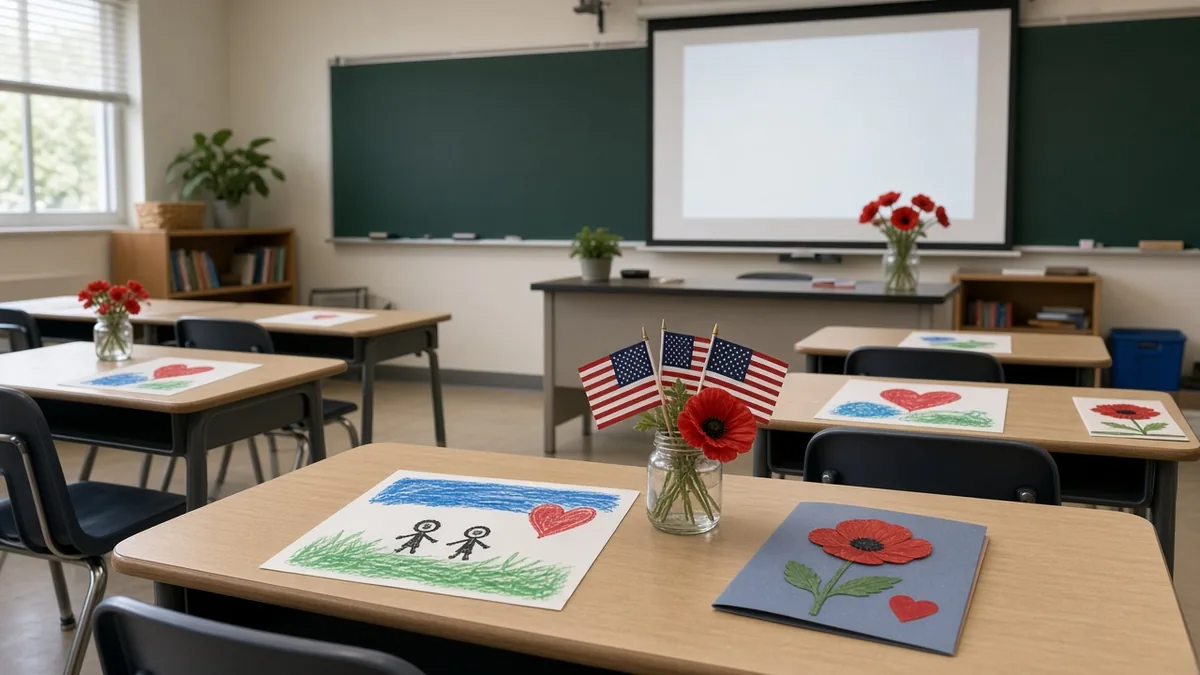
Open the drawing board and model a poster with a flag, a short message and a border. Students then make their own on paper. Display a few on screen at the end and talk about which messages are clearest.
9. Fair turns for sharing
Use the random name picker to choose who reads a letter or answers a question. Random, visible picking feels fair and keeps sharing moving without the same few hands every time.
10. Exit ticket: "What I learned"
Finish with an exit ticket: "Write one way Veterans Day is different from Memorial Day" and "Write one reason we celebrate on 11 November." You will see at a glance whether the main ideas landed.
A ready-made Veterans Day lesson plan (40 minutes)
| Minutes | Activity | Widget |
|---|---|---|
| 0-3 | Veterans Day or Memorial Day? sort | This or That |
| 3-10 | Five-date timeline with predictions | Text widget + timer |
| 10-12 | Moment of silence (if near 11:00) or reflection | Timer |
| 12-27 | Thank-you letter writing | Timer + noise meter |
| 27-35 | Sharing with random picks | Name picker |
| 35-40 | Exit ticket | Exit ticket |
Save it as a board so you can reuse it next year. If you build your daily routines on screen, our guide to classroom screen ideas shows how to keep one board per lesson.
Adapting by grade level
- K-2: focus on "helpers who served our country", one or two dates, a drawing and a short thank-you sentence.
- Grades 3-5: add the full timeline, the sort and a letter with the three-part frame.
- Grades 6-8: compare the 1968 and 1975 laws, discuss why the date mattered to so many people, and prepare interview questions for a guest.
- High school: connect to civics: how federal holidays are created by Congress and why states could keep their own dates. The VA also publishes a free Veterans Day Teachers Resource Guide with more background and activities for older students.
Cross-curricular extensions
Veterans Day connects to almost every subject, so you can spread it across the week instead of squeezing it into one period.
- Math: work out how many years ago each date in the timeline was. From 1918 to 2026 is 108 years; from 1954 is 72 years. Older students can find how long the holiday sat on an October Monday (the 1971 to 1977 observances).
- ELA: turn the guest Q&A into an interview write-up, or compare the tone of a thank-you letter with a news report. The writing frame from activity 4 doubles as an opinion-writing warm-up.
- Social studies: map the five branches students named in activity 6, or discuss why Congress, rather than the President alone, creates federal holidays.
- Art: design a classroom "thank you" banner together on the drawing board, then make the paper version for the hallway.
- Music: listen to a patriotic piece and discuss how music is used at ceremonies.
Keep each extension short, five to ten minutes, and reuse the same board so the routine feels familiar. When students see the same widgets every day, they spend their energy on the ideas, not on figuring out the screen. A noise meter set to a calm level also helps during group work on a day that should feel thoughtful.
Keeping it respectful and inclusive
Veterans Day can be personal. Some students have a parent who is deployed, and some families have lost someone. A few simple habits help:
- Keep sharing optional and never ask students to describe combat or injuries.
- Use neutral, factual language about wars, and focus on service rather than glory.
- Let families know about a guest visit ahead of time.
- Pair the day with your social-emotional routines; our SEL classroom screen guide has check-in ideas.
Fitting it into a busy autumn
Veterans Day sits between two other observances you may already be running. Late October brings Red Ribbon Week and classroom Halloween activities, and two weeks after Veterans Day come our Thanksgiving classroom activities. The thank-you letter routine here leads naturally into a November gratitude theme. If students need a reset between activities, pick one of our no-prep brain breaks.