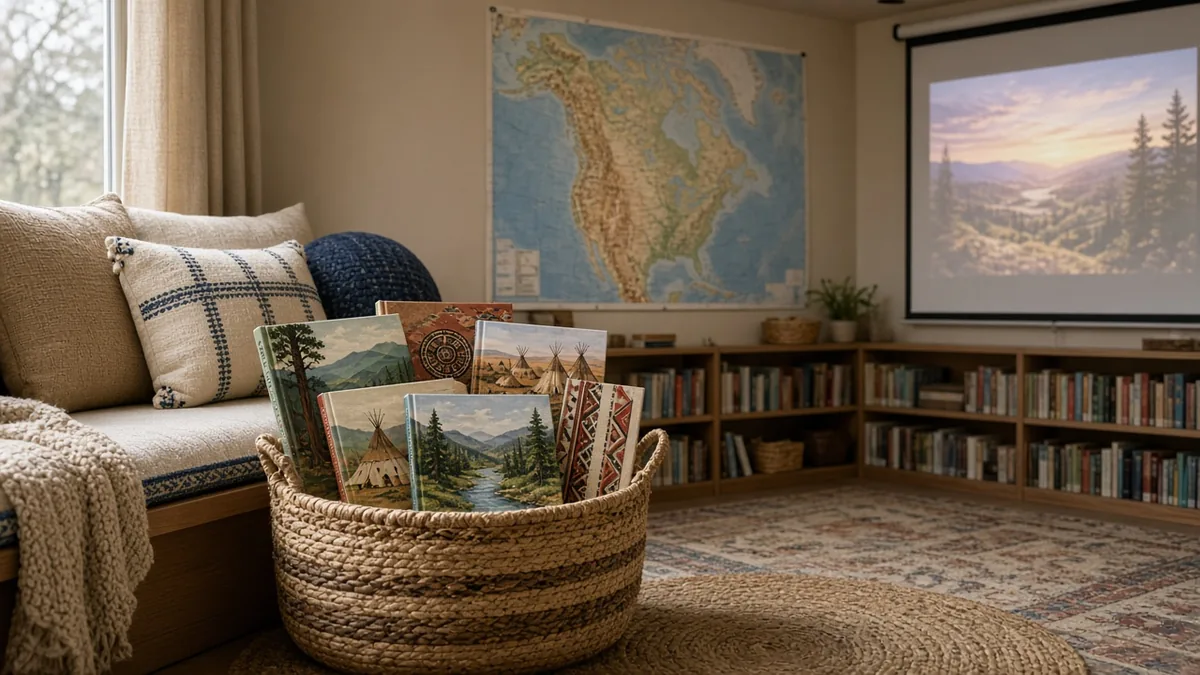
November is Native American Heritage Month in the United States, and a classroom screen makes it easy to build short, respectful daily activities around it. This guide gives you Native American Heritage Month classroom activities you can run from one projected board: a daily spotlight, primary-source analysis, a land-acknowledgment discussion for older students, place-name research, and reflection prompts. Every activity uses free tools you already have on MyClassScreen, and every fact here comes from federal sources linked below.
The aim is to teach about Native peoples as living, present-day nations with distinct histories, languages and governments, not as a single culture from the past.
A short history of Native American Heritage Month
The month grew out of a much older campaign. According to the Library of Congress Native American Heritage Month portal:
- Dr. Arthur C. Parker, a Seneca, persuaded the Boy Scouts of America to set aside a day for the "First Americans" in the early 1900s.
- In 1915 the American Indian Association approved a plan for an American Indian Day, and Rev. Sherman Coolidge, an Arapaho, issued a proclamation on 28 September 1915.
- Red Fox James, a Blackfoot, rode horseback from state to state and on 14 December 1915 presented endorsements from 24 state governments at the White House.
- The first state American Indian Day was declared by the governor of New York in May 1916.
- In 1990, President George H. W. Bush approved a joint resolution designating November 1990 "National American Indian Heritage Month". Similar proclamations, under several names, have been issued every year since 1994.
There is also a single day to note. The Native American Heritage Day Act of 2009 designated the Friday after Thanksgiving as Native American Heritage Day. In 2026 that is Friday, 27 November, the day after Thanksgiving on 26 November.
Before you start: three teaching principles
These principles, drawn from the Smithsonian's Native Knowledge 360° education initiative and the federal teaching resources listed on the heritage month portal, keep activities accurate and respectful:
- Be specific. Name the nation, such as the Navajo Nation, the Cherokee Nation or the Seneca Nation, instead of "Native Americans" as a single group. There are hundreds of federally recognized tribes, each with its own history and government.
- Use present tense. Native people are not only part of history. Include contemporary authors, scientists, artists, athletes and leaders.
- Skip costumes and crafts that imitate sacred items. Headdresses, "tribal" face paint and dress-up activities reduce many cultures to stereotypes. Use primary sources and Native voices instead.
Activity 1: A daily "Nation spotlight" on the board
Time: 5 minutes a day. Grades: 2 to 12.
Set up one board for the month with a text widget titled "Today's spotlight". Each school day, feature one nation or one person with three facts: where the nation's homelands are, one thing about its present-day government or community, and one contribution or achievement. Rotate between regions so students see the diversity of Native nations.
To pick who presents, use the random name picker. Students research a spotlight in pairs during the week and present it in two minutes. A classroom timer keeps presentations short and fair.
Activity 2: Primary-source analysis
Time: 20 to 30 minutes. Grades: 5 to 12.
The heritage month portal's teachers page links ready-to-use activities from the National Archives, the Library of Congress, the National Endowment for the Humanities, the National Park Service and the Smithsonian. Options include analyzing a historical photograph, reading a petition, and primary-source sets on topics such as Native American voting rights and boarding schools.
Run it on screen like this:
- Project the primary source large on the board.
- Put three questions in a text widget: What do you see? What do you think was happening? What do you still wonder?
- Give pairs four minutes on the timer, then gather answers with a live poll or open discussion.
- Reveal the source's background and compare it with the class's first reading.
Choose sources carefully for your grade. Topics like boarding schools need context and preparation, especially with younger students.
Activity 3: Whose land is our school on?
Time: 30 minutes. Grades: 4 to 12.
Ask students to find out which Native nations lived, and in many cases still live, in your area. Your state historical society, a local tribal nation's own website, or the portal's resources are good places to start. Then discuss:
- What are the nation's names for local rivers, mountains or places?
- Is the nation still present in your region today, and how is it governed?
- How did the land come to be part of the state?
Older students can compare a few formal land acknowledgments and discuss what makes one meaningful. Keep the focus on learning about the people, not on writing a statement for its own sake.
Activity 4: Place names around us
Time: 20 minutes, plus homework. Grades: 3 to 8.
Many US states, cities and rivers carry names that come from Native languages. Put a map on the board and ask students to list local or state place names they think might come from a Native language. Using the wheel spinner, assign each pair one name to research: which language it comes from, what it means, and whether that meaning is certain or disputed. Remind students that many popular "meanings" online are guesses; teach them to look for a tribal nation or university source.
Activity 5: Read a Native author
Time: 15 minutes a day for a week. Grades: K to 12.
Choose a book, poem or short story by a Native author for read-aloud or independent reading. The portal's teacher resources include "Remember" by Joy Harjo, a Muscogee (Creek) poet who served as US Poet Laureate. Put a reading timer on the board, and use a this or that widget or a drawing board for quick responses afterward.
Activity 6: Exit tickets that check understanding
End lessons with an exit ticket. Good prompts:
- Name one Native nation and one fact about it today.
- What is one thing you learned that surprised you?
- What is one stereotype you could now explain is inaccurate?
- What question do you still have?
Read the answers to plan the next day's spotlight and to catch misconceptions early.
Adapting the activities by grade level
Kindergarten to grade 2. Keep it to the daily spotlight and a read-aloud. Use one nation per week rather than one per day, and focus on simple, concrete facts: where the nation lives today, a word in its language, a food or tradition the nation itself shares publicly.
Grades 3 to 5. Add place-name research and short partner presentations. Students at this age can compare two nations from different regions and notice how their homelands, languages and governments differ.
Grades 6 to 8. Add primary-source analysis and the "whose land" discussion. Students can begin to read treaties and petitions with support, and connect them to state history standards.
Grades 9 to 12. Use the full set, and let students lead. Primary sources on voting rights or federal policy, current news from tribal nations, and comparisons of land acknowledgments all suit older students. Encourage them to cite tribal and federal sources, not unsourced websites.
A one-week plan you can project
| Day | Board activity | Tools |
|---|---|---|
| Monday | History of the month, plus first spotlight | Text widget, timer |
| Tuesday | Primary-source analysis | Text widget, live poll |
| Wednesday | Whose land is our school on? | Map, timer |
| Thursday | Place-name research | Wheel spinner, timer |
| Friday | Read-aloud and exit ticket | Timer, exit ticket |
Repeat the daily spotlight every day. In the week of Thanksgiving, use Monday to Wednesday to prepare a Native American Heritage Day reflection, since the day itself falls on the Friday after Thanksgiving, usually a school holiday.
Connecting to other November lessons
November is a busy month on the classroom calendar. Our recent guides cover Veterans Day classroom activities, which can include the long history of Native service in the US military; Election Day classroom activities, which pair well with a lesson on Native American voting rights; and Thanksgiving classroom activities. For a lighter mid-month theme, our new guide to World Kindness Day classroom activities covers 13 November. Planning other November lessons? Try our Diwali classroom activities. Our Day of the Dead activities use the same respectful one-screen format. For structured discussion skills, see SEL on the classroom screen.
Checklist: Native American Heritage Month on one screen
- [ ] Set up a month-long board with a daily spotlight text widget.
- [ ] Pick nation-specific sources, and use present tense.
- [ ] Choose primary sources from the federal teaching resources and preview them for your grade.
- [ ] Research the Native nations of your own area.
- [ ] Use the random name picker and timer for fair, short presentations.
- [ ] Close lessons with an exit ticket and adjust the next day.