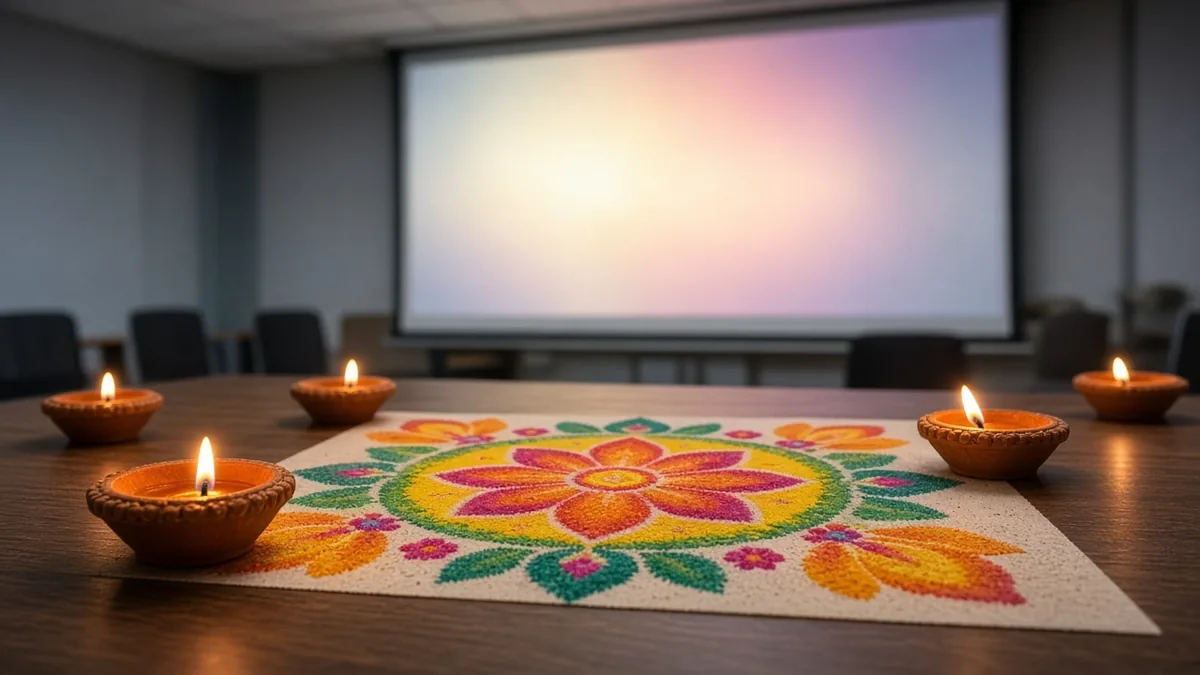
These Diwali classroom activities fit on one classroom screen and take 10 to 40 minutes each: a rangoli symmetry challenge, a diya counting game, a "row of lights" vocabulary warm-up, a festival map and a student-led sharing circle. Diwali falls on Sunday, 8 November 2026, so the school days around it, Thursday 5 and Friday 6 November or Monday 9 November, are the natural time to run them.
Diwali is a major festival for millions of families, and many classrooms include students who celebrate it. The goal of these activities is to help every student learn what Diwali is, give students who celebrate a chance to share if they want to, and keep the focus on culture, light, art and community rather than acting out religious rituals.
What is Diwali? A one-slide explainer for students
Before any activity, put a short explainer on the board. According to Britannica Kids, Diwali (also spelled Divali) is one of the major religious festivals in Hinduism, Jainism and Sikhism. It lasts five days and falls during the lunar months of Ashvina and Karttika, usually in late October or November.
Diwali is also called the Festival of Lights. Its name comes from the Sanskrit word dipavali, meaning "row of lights". The best-known custom is lighting small clay oil lamps called diyas, which brighten homes and temples. Families decorate floors with colorful patterns, visit relatives, share food, exchange gifts and wear new clothes.
Different communities remember different stories at Diwali:
- In North India, many Hindus celebrate Rama's return to the city of Ayodhya after defeating Ravana.
- In South India, the festival marks Krishna's victory over the demon Narakasura.
- Jains remember Mahavira, and the lamps celebrate the light of his knowledge.
- Sikhs have celebrated the return of Guru Hargobind to Amritsar since the 1700s, a celebration also known as Bandi Chhor Divas.
Keep this slide simple. Put the five key words on screen with the text widget: Diwali, diya, rangoli, Festival of Lights, row of lights. Leave them visible all lesson so students can use them in their writing.
1. Rangoli symmetry challenge (math and art, 30 minutes)
Rangoli are decorative floor patterns made with colored rice, sand, powder or flower petals. Many are symmetrical, which makes them a natural fit for a geometry lesson.
On the screen: open the drawing board and draw a simple grid with a vertical and horizontal line through the center. Draw one quarter of a pattern, a petal, a dot and a curve, and ask a student to come up and complete the mirror image.
At desks: give each student square grid paper and colored pencils. Their task is to design a rangoli with:
- Grades K to 2: one line of symmetry.
- Grades 3 to 5: two lines of symmetry.
- Grades 6 to 8: rotational symmetry of order 4 or 8.
Run a classroom timer for 20 minutes so students know when to start coloring. When it ends, photograph a few designs and show them on the board for a gallery walk.
Extension: ask older students to count how many times their pattern repeats and explain how that relates to the angle of rotation. A pattern that repeats 8 times around the center turns by 45 degrees each time.
2. Diya counting and math game (K to 3, 15 minutes)
Young learners can practice counting, adding and number bonds with a "light the diyas" game.
On the screen: draw or display a row of ten unlit lamps. Use the dice roller to roll one or two dice. Students say how many lamps to "light" (color in) and how many are still dark.
- Roll a 4: four lamps lit, six still dark. 4 + 6 = 10.
- Roll a 3 and a 5: eight lamps lit, two dark. 3 + 5 + 2 = 10.
Keep score as a class with the scoreboard, or let small groups race to light all ten lamps first. The idea of a "row of lights" ties back to the meaning of the word Diwali, so students remember both the math and the vocabulary.
Safety note: if you bring real diyas in to show students, keep them unlit. Battery tea lights give the same glow without an open flame.
3. "Row of lights" vocabulary and word work (grades 2 to 6, 15 minutes)
Use Diwali words to practice spelling, syllables and dictionary skills.
- Put these words on screen: festival, lantern, lamp, celebrate, sweets, pattern, symmetry, family, tradition, light.
- Use the random name picker to choose a student, then spin to choose a word.
- The student says the word, claps the syllables and uses it in a sentence about Diwali.
For older students, add the borrowed words diya and rangoli, and discuss how English takes in words from other languages. Ask: "What other English words came to us through Indian languages?" Shampoo, pajamas and bungalow are classic examples that students enjoy discovering in a dictionary.
4. Festival of lights world map (grades 3 to 8, 30 minutes)
Diwali is celebrated in India and by communities around the world. A map activity helps students see that geography.
On the screen: show a world map and mark India first. Then ask students, using classroom atlases or approved websites, to research where else Diwali is widely celebrated and pin those countries.
Give groups a short research card with three questions:
- Where is this place on the map?
- How do people there mark Diwali?
- What is one thing that is similar to a celebration you know?
Use the group maker to form teams of three or four, and run the timer so research does not drift. Groups share one fact each at the end. Remind students to note their source for every fact so you can model good research habits.
5. Light and lamps science mini-lesson (grades 3 to 6, 20 minutes)
Diwali is a festival about light, which makes it a friendly hook for a short science lesson.
- Question on screen: "Why do people light lamps when nights get longer?"
- Discuss: in the Northern Hemisphere, autumn days get shorter, so evenings are darker earlier. Light has always mattered to people at this time of year, from oil lamps to electric lights.
- Quick investigation: use a flashlight and objects on a desk to explore shadows. How does the shadow change when the light moves closer or further away?
Finish with a this or that vote: "Which lights a room better: one bright lamp or many small ones?" Students explain their reasoning before you reveal what they observe.
6. Student sharing circle (all grades, 15 minutes)
If students in your class celebrate Diwali, they may love the chance to talk about it. Others may prefer not to. Make sharing an invitation, never an assignment.
On the screen: post three gentle prompts:
- "One thing my family does at this time of year is..."
- "A food we share at celebrations is..."
- "A tradition I would like to learn more about is..."
Every student can answer at least one prompt, whether or not they celebrate Diwali. Use a traffic light as a talking signal: green means it is your turn to share, yellow means wrap up, red means pass to the next person.
A one-screen Diwali board layout
You can run the whole lesson from a single board in MyClassScreen:
| Widget | What it shows |
|---|---|
| Text | Key words: Diwali, diya, rangoli, Festival of Lights |
| Timer | Countdown for each activity |
| Drawing board | Rangoli grid and student drawings |
| Dice roller | Diya counting game |
| Random name picker | Who answers next |
| Exit ticket | One thing I learned about Diwali |
Save the board once and reuse it every year. Our guide to classroom Halloween activities uses a similar layout if you want a second seasonal template.
End with an exit ticket
Close the lesson with an exit ticket on the board. Ask students to answer one question:
- K to 2: "Draw one thing you learned about Diwali."
- 3 to 5: "What does the word Diwali mean, and why are lamps important?"
- 6 to 8: "Name two communities that celebrate Diwali and one story each remembers."
Read the answers before your next lesson so you can correct any misunderstandings.
Checklist: Diwali in your classroom
- [ ] Check the date: Diwali 2026 is Sunday 8 November.
- [ ] Put a one-slide explainer and key words on the board.
- [ ] Choose two or three activities that suit your grade.
- [ ] Keep any lamps unlit or use battery lights.
- [ ] Invite, but do not require, students to share their traditions.
- [ ] Finish with an exit ticket to check understanding.
For another cultural celebration this season, try our Día de Muertos lesson.