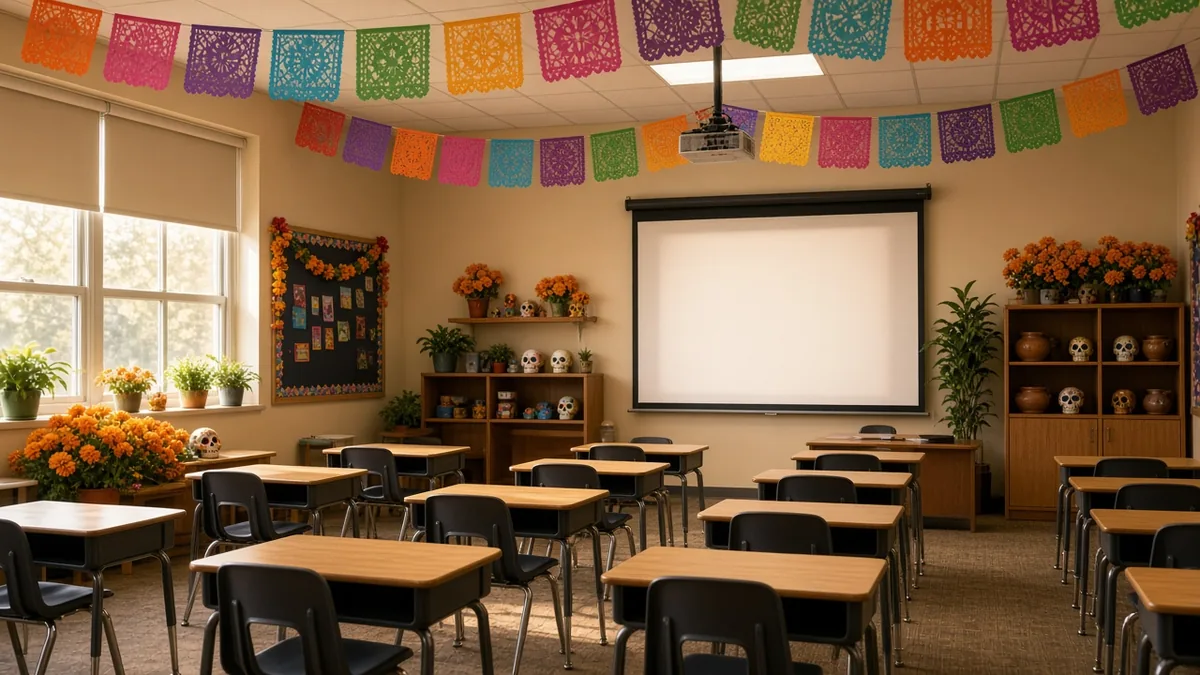
These Day of the Dead classroom activities help students learn what Día de Muertos is and why it matters, using one classroom screen and 15 to 40 minutes per activity: a short explainer, a marigold color and symmetry project, a papel picado paper-cutting lesson, a vocabulary match, a "people we remember" writing activity and a sharing circle. Día de Muertos is typically observed on 1 and 2 November, so in 2026 the natural days to teach it are Friday 30 October or Monday 2 November.
The aim is to teach the holiday accurately and respectfully. Día de Muertos is a celebration of remembrance rooted in Indigenous traditions of Mexico, and it is not "Mexican Halloween". Some students in your class may celebrate it with their families, and they should be invited, never required, to share. The activities focus on culture, art, language and memory, and avoid asking students to recreate religious rituals.
What is the Day of the Dead? A one-slide explainer
Start with a short explainer on the board. Keep it to four points:
- What: Día de Muertos, or Día de los Muertos, is a holiday honoring family members and friends who have died. Families remember them with joy rather than fear.
- When: it is typically observed on 1 and 2 November. Preparations often begin at the end of October.
- Where: it is celebrated in Mexico and also observed in other parts of Latin America and the United States.
- Why it matters: UNESCO added the Indigenous festivity dedicated to the dead in Mexico to its Representative List of the Intangible Cultural Heritage of Humanity in 2008.
Britannica describes the holiday as rooted in the beliefs of Indigenous peoples of Mesoamerica, blended over time with the Catholic observances of All Saints' Day and All Souls' Day. That one sentence is enough history for most elementary classes.
Important point for students: Día de Muertos and Halloween fall close together on the calendar, but they have different origins and meanings. Ask students to name one way they are different after the explainer.
Key words for the board
Put a short glossary on a text widget and leave it up all lesson.
| Spanish | English | What it is |
|---|---|---|
| ofrenda | offering | a home altar with photos, candles, flowers and food |
| cempasúchil | marigold | the orange and yellow flower used to decorate ofrendas |
| papel picado | punched paper | colorful paper banners with cut-out patterns |
| calavera | skull | often a decorated sugar skull or a skeleton figure |
| pan de muerto | bread of the dead | a sweet bread baked for the holiday |
| La Catrina | — | an elegant skeleton figure created by artist José Guadalupe Posada |
Practise the pronunciation together. If a student speaks Spanish at home, they may enjoy leading this part.
1. Marigold color and symmetry (K to 5, 30 minutes)
Marigolds, called cempasúchil in Mexico, are among the most recognizable features of the holiday. Britannica notes that their bright color and strong scent are believed to help guide spirits home.
Activity:
- Show a photo of marigolds on the screen.
- Students cut circles of orange and yellow tissue paper, layer five or six, and pinch them in the middle to make a paper flower.
- Older students can draw a flower with radial symmetry, where petals repeat around a center point, and count the lines of symmetry in their design.
Set the classroom timer for 20 minutes of making and 10 minutes of sharing. The flowers make a bright class display.
2. Papel picado paper cutting (grades 2 to 8, 35 minutes)
Papel picado means "punched paper". The banners have intricate cut-out patterns and are hung across streets, homes and ofrendas.
Activity:
- Give each student a sheet of colored tissue paper.
- Fold it in half, then in half again, then into a triangle.
- Cut small shapes along the folded edges: triangles, half-circles, diamonds.
- Unfold carefully to reveal a symmetrical pattern.
- String the sheets together into one class banner.
This doubles as a math lesson on line symmetry. Ask students to predict what the pattern will look like before they unfold. Cutting along a fold makes a mirror image, and each extra fold multiplies the repeats.
3. Vocabulary match game (grades 1 to 6, 15 minutes)
Use the glossary to play a quick match game.
- Read an English description aloud, such as "a sweet bread baked for the holiday".
- Use the random name picker to choose a student.
- The student names the Spanish word. If they are stuck, they can ask a "lifeline" from their table.
Keep score on the scoreboard by table group. Five or six rounds is plenty.
4. "People we remember" writing (grades 3 to 8, 25 minutes)
At the heart of Día de Muertos is remembering people with love. A gentle classroom version invites students to write about someone or something they remember, with clear choices so no one feels pressured.
Offer three options on the screen:
- A family member or friend they want to remember and why.
- A famous person from history whose work they admire.
- A pet they remember fondly.
Students write five to eight sentences: who, one memory or fact, and one thing they would like others to know. Make it clear that sharing aloud is optional. Some students may be dealing with a recent loss, so tell families about the activity in advance and offer a neutral option, such as writing about a historical figure.
5. Ofrenda elements, a picture lesson (grades 2 to 6, 20 minutes)
Instead of building an altar, which is a family practice, show photos of ofrendas and talk about what students see. Britannica explains that ofrendas often include elements that represent the four elements of nature:
- Fire: candles that light the way.
- Water: for purification and to quench thirst after a long journey.
- Earth: food, such as pan de muerto, fruit and favorite dishes.
- Wind: papel picado, whose cut-outs move in the air.
Ask students to sort photo cards into the four groups, then discuss which item they find most interesting and why.
6. Sharing circle (all grades, 15 minutes)
End the week with a sharing circle. Put two questions on the screen:
- What is one thing you learned about Día de Muertos?
- What is one way your family remembers people, or celebrates, at this time of year?
Use the traffic light to signal turn-taking. Students may pass. Thank every student who shares, and avoid comparing traditions as better or worse.
A one-screen Day of the Dead board
A board that holds the whole lesson:
- Top left: the four-point explainer.
- Top right: the glossary table.
- Bottom left: the timer.
- Bottom right: the random name picker.
Choose an orange or marigold background. Save it as a template so you can reuse the layout next year. If you are planning a run of cultural lessons this term, our Diwali classroom activities and Native American Heritage Month activities use the same one-screen format.
A short note to families
Sending a note home before the lesson builds trust and gives families who celebrate a chance to contribute. A template you can adapt:
This week our class will learn about Día de Muertos, a holiday observed in Mexico and by many families in the United States on 1 and 2 November. We will learn what the holiday means, make paper marigolds and papel picado, and practise some Spanish vocabulary. Students may choose to write about a person, historical figure or pet they remember; sharing is always optional. If your family celebrates Día de Muertos and would like to share a tradition, photo or recipe with the class, please let me know.
Keep the note short and positive. If a family tells you about a recent loss, offer that student the historical-figure option quietly.
Media students may already know
Many students first heard of the holiday through the 2017 Disney and Pixar film Coco, which Britannica notes helped introduce Day of the Dead traditions to a wide audience. If students mention it, use it as a starting point: ask which parts of the film they think are based on real traditions, then check against the glossary on the board.
Teaching Día de Muertos respectfully
A few principles keep the lesson accurate and kind:
- Do explain the holiday's Indigenous roots and its meaning of remembrance.
- Do invite students who celebrate to share if they want to.
- Do use correct names and pronunciation.
- Don't treat it as a costume party or a Halloween variant.
- Don't ask students to build personal altars or perform religious practices.
- Don't single out students by background or ask them to speak for a whole culture.