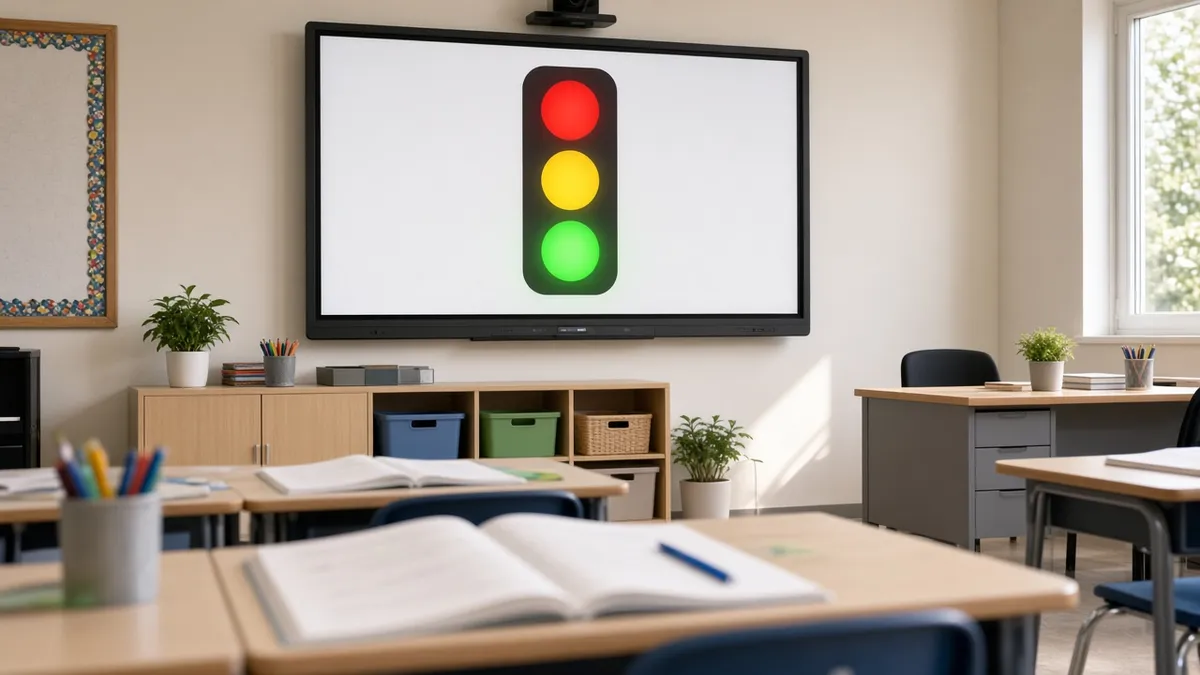
A traffic light behavior system uses red, yellow and green to show students what is expected right now. It works best as a whole-class signal for noise level and work mode: green for talk and collaborate, yellow for whisper or partner voices, red for silent independent work. Used that way, it is clear, positive and quick. Used as a public chart where individual children's names move to red, it tends to embarrass the same few students and rarely changes behavior. This guide shows how to set up the class-signal version, what to say, and when to use something else.
You can project a free traffic light on your board and click between colors in a second, which makes it easy to try the routine below tomorrow.
The system works best when students already know a short set of positive classroom rules.
Two very different traffic light systems
Teachers use the name for two different things, and the difference matters.
| Whole-class signal | Individual clip or name chart | |
|---|---|---|
| What it shows | the expected voice level or work mode | one child's behavior "status" |
| Who it targets | everyone, equally | individual students, publicly |
| Tone | an instruction | a judgment |
| Typical effect | quick, shared expectation | public embarrassment for a few kids |
| Fits with | PBIS, CHAMPS, routines | older color-chart systems |
This article recommends the first version. If your school requires an individual system, keep it private (a sticky note on a desk, a quiet conference) rather than on a wall.
What each color means (a sample set)
Keep the meanings short and post them next to the light for the first few weeks.
- Green: collaborate. Table voices, move to get supplies, ask a neighbor.
- Yellow: focus. Whisper or partner voices only, stay in your seat, raise a hand for help.
- Red: silent work. No talking, eyes on your own work, signal with a hand if you need something.
Some teachers flip the meaning of red to "stop and look at me" for attention. Pick one meaning and stick to it, or students will guess.
Teach it like a routine, not a rule
- Introduce it with a demo. Show green, then have students practice table talk for 30 seconds. Switch to yellow and practice whispering. Switch to red and hold silence for 20 seconds.
- Name the why. "Different work needs different voices. The light tells you which one."
- Practice transitions. Change colors mid-activity a few times on day one so the switch becomes automatic.
- Acknowledge it. "Table 3 switched to whisper voices the moment the light turned yellow. Thank you."
- Review after breaks. Re-teach after holidays and long weekends.
This mirrors how PBIS frameworks teach expectations: state them, model them, practice them and acknowledge students who meet them. The Center on PBIS has free resources on teaching expectations if your school uses that framework.
Scripts that keep it positive
- "We are moving to yellow. Partner voices, please."
- "The light is red for the next eight minutes. I will set the timer."
- "We drifted above yellow. Let us reset: three seconds of silence, then whisper voices."
- "Green for the next ten minutes. Use it to plan with your group."
Avoid naming a child while pointing at red. Speak to individuals privately and quietly.
Pair the light with a timer
The light tells students how to work; a timer tells them how long. Put the traffic light and a classroom timer on screen together. "Red for 10 minutes, then green for sharing" is far easier to follow than an open-ended silence. Our timer strategies post has more routines.
Sample lesson flow using the light
| Lesson phase | Light | Minutes |
|---|---|---|
| Warm-up question | red | 5 |
| Turn and talk | yellow | 3 |
| Mini-lesson | red | 10 |
| Group task | green | 15 |
| Exit ticket | red | 5 |
Students learn to look at the board when the activity changes, and you talk less. Add an exit ticket at the end to close the loop.
Using the light with a noise meter
A noise meter measures volume automatically, which can help some classes. The traffic light is simpler and does not react to a dropped book or a laugh. Many teachers use the light as the expectation and the meter only for loud activities. Our noise meter strategies post explains how to calibrate one.
Adapting by grade level
- K-2: use pictures next to each color (mouth closed, whisper, talking). Practice daily for the first two weeks. Keep red periods short.
- Grades 3-5: let students help write the expectations for each color. Add a short timer to every red period.
- Middle school: frame it as "work mode" rather than behavior. Teens respond better to "focus mode" and "collab mode" language than to traffic metaphors, so label the colors that way.
When the traffic light does not work
- One or two students keep struggling. That is a sign to support them individually, privately, not to move their name on a chart. Check whether they understand the task and can access it.
- The whole class ignores it. Re-teach and practice. If it still fails, the task may not match the voice level (asking for silence during a group project, for example).
- It becomes background noise. Change colors less often and acknowledge good switches out loud.
Alternatives and add-ons
- CHAMPS charts spell out Conversation, Help, Activity, Movement and Participation for each activity. See our CHAMPS screen guide.
- Hand signals (one finger for bathroom, two for water) cut interruptions during red periods.
- Quiet monitors with fun animations reward a calm room; try our quiet monitor recipes.
- Whole-class points on a scoreboard reward the group, not individuals.
- Visual routines for transitions; see transition timers.
For a wider view of the tools that support positive behavior, read our PBIS classroom screen guide.
Common mistakes to avoid
- Changing colors too often. If the light flips every two minutes, students stop looking at it. Plan the switches around real changes in the activity.
- Using red as a punishment. Red should mean "silent work," not "you are in trouble." When it becomes a consequence, students resent it and you lose a useful work mode.
- Leaving it on green all day. A light that never changes is wallpaper. Turn it off when you do not need it.
- Skipping the practice. A light introduced with one sentence on a busy Monday rarely sticks. Spend five minutes rehearsing each color.
- Mixing meanings. If red means silent work in math and "stop and look" in science, students guess. Keep one meaning across subjects.
- Ignoring good switches. The fastest way to make the routine stick is to notice when it works.
Supporting students who need more help
Some students find voice-level shifts hard: very social kids, students with attention differences and multilingual learners still building classroom language. A few low-key supports help without singling anyone out:
- Put a small printed copy of the three colors on desks or table caddies.
- Give a quiet, private reminder ("We are on yellow") rather than a public one.
- Pair words with pictures or gestures for each color.
- Warn the class one minute before a switch ("Green in one minute, finish your sentence").
- Work with your school's support staff if a student needs an individual plan.
A low-tech backup
Screens freeze and projectors fail. Keep a paper version handy: three colored circles on a strip of card with a clothespin you move between them, or three colored cups stacked on your desk. Teach students that the paper light means exactly the same thing as the screen light, so the routine survives a dead projector or a substitute day.
Tips for substitutes
Add one line to your sub plans: "We use a traffic light for voice levels: green talk, yellow whisper, red silent. It is on the board." Leave the light open on the screen and note when each color is used in the day's lessons. Students usually remind a substitute themselves, which keeps the routine running.
A 5-minute setup for tomorrow
- Open the traffic light on your board.
- Write the three meanings on a sticky note or slide next to it.
- Plan where in tomorrow's lesson each color will appear.
- Teach and practice it in the first five minutes.
- Acknowledge the first good switch out loud.
Pair green-light days with one of these whole class reward ideas.