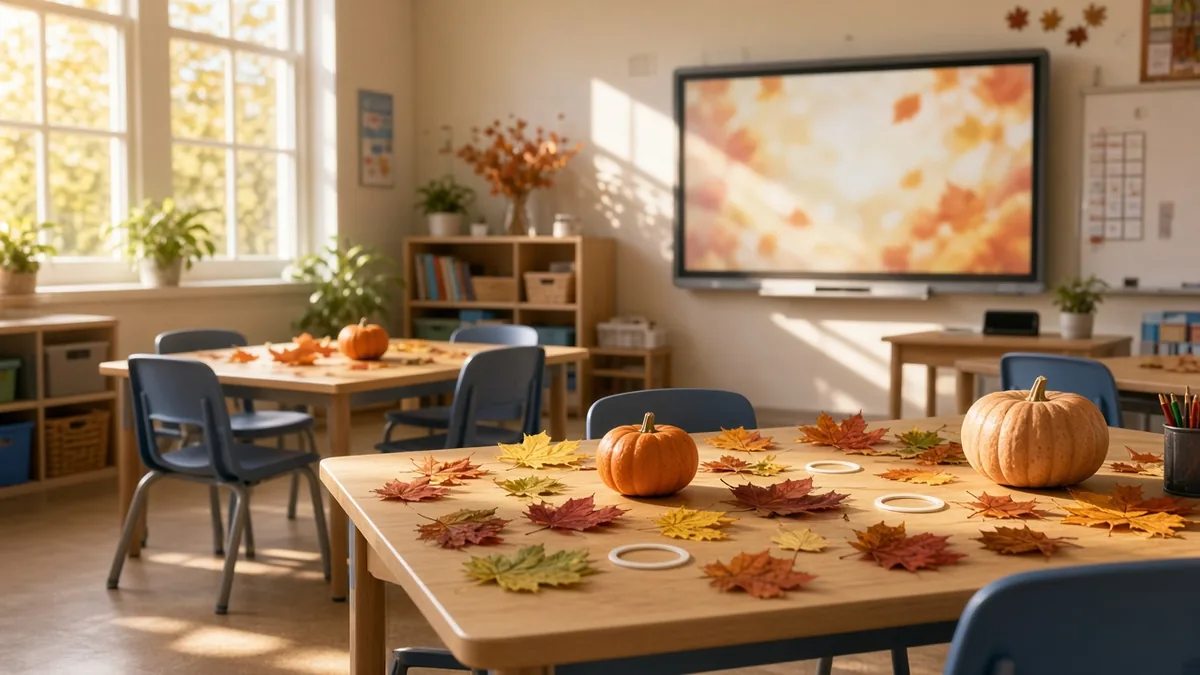
These fall classroom activities run from one screen and take 10 to 40 minutes each: a leaf sorting challenge, a pumpkin estimation station, an autumn word warm-up, a "why do leaves change color?" science mini-lesson, a fall writing prompt wheel and a gratitude graph. None of them needs a holiday, so you can use them any time from late September to the Thanksgiving break, and each one comes with the widgets to put on your board.
Fall is a busy term. After the first weeks of routines, students are ready for something new, and the season gives you free, familiar material: leaves, pumpkins, apples, cooler weather and shorter days. The activities below turn that material into math, science, writing and SEL practice, so the theme supports the curriculum instead of replacing it. If you want Halloween-specific ideas, see our classroom Halloween activities; for late November, our Thanksgiving classroom activities pick up where this list ends.
How to set up a fall board on one screen
A themed board makes the routine feel new without new prep. A simple layout:
- Top left: a classroom timer set for the current activity.
- Top right: a text widget with the task in one sentence.
- Bottom left: a random name picker loaded with your class list for sharing.
- Bottom right: a traffic light to show talk level: green for partner talk, yellow for whispers, red for silent work.
Pick a warm orange or brown background to set the season. Save the board once and reuse it for every activity in this post by changing only the text widget.
1. Leaf sorting and classifying (K to 5, 20 minutes)
Collect a bag of fallen leaves before school, or ask students to bring two each. On the board, show three sorting rules in turn:
- Sort by color: green, yellow, orange, red, brown.
- Sort by edge: smooth edges or toothed edges.
- Sort by shape: single leaf or a leaf made of several leaflets.
Groups of four sort their leaves on paper, then use the group maker to swap tables and guess the rule another group used. Older students can make a tally chart or bar graph of the colors they found.
Extension for grades 3 to 5: ask each group to write one sentence that explains their sorting rule so clearly that a younger student could follow it.
2. Pumpkin estimation station (K to 5, 15 minutes)
Bring in one small pumpkin and put a photo of it on the board. Ask four questions, one per day of the week if you want to stretch it out:
- How many inches around is it?
- How heavy is it, in pounds?
- How many lines (ribs) run from top to bottom?
- Will it sink or float?
Students write their estimates on sticky notes. Then measure with a string and a ruler, weigh it on a bathroom scale, count the ribs together and test it in a bucket of water. Most pumpkins float, which surprises a lot of students and leads to a short talk about density: a pumpkin is mostly hollow and full of air.
Show the class estimates as a line plot. Ask which estimate was closest and how far the furthest one was from the real answer. It is a short, real lesson in measurement and range.
3. Autumn word warm-up (grades 1 to 6, 10 minutes)
Put the word AUTUMN LEAVES on the screen and set the timer for three minutes. Students write as many words as they can using only those letters. Tune, mute, seal, steam, value and meant all work.
Then share answers with the random name picker. Award one point for a word, two for a word nobody else found. The warm-up builds spelling and vocabulary and settles the class at the start of a lesson.
Variation for older students: use HARVEST MOON or FALLING TEMPERATURES and require words of five letters or more.
4. Why do leaves change color? (grades 2 to 6, 25 minutes)
This short science lesson answers a question students ask every year.
Explain it in three slides:
- Leaves are green in summer because they are full of chlorophyll, the pigment plants use to make food from sunlight.
- As days get shorter and cooler in fall, many trees stop making chlorophyll. The green fades.
- Yellow and orange pigments that were in the leaf all along become visible. Some trees also make red and purple pigments in fall.
The U.S. Forest Service explains the same three steps in its guide to fall color, which is a good link to share with families.
Hands-on follow-up: a simple leaf chromatography test. Crush a leaf into a little rubbing alcohol in a cup, stand a strip of coffee filter in the liquid, and wait about 30 minutes. Bands of color creep up the paper. Adults should handle the alcohol, and the activity works best with green leaves from different trees.
Students record a before-and-after drawing on the board's drawing tool or on paper.
5. Fall writing prompt wheel (grades 2 to 8, 20 minutes)
Load the wheel spinner with fall writing prompts and spin once for the whole class or once per table. Prompt ideas:
- Describe the sound of walking through dry leaves to someone who has never heard it.
- Write a letter from a tree to its leaves.
- Explain how to carve a pumpkin to an alien.
- What is the best thing about the first cold morning of the year?
- Write a recipe for a perfect fall afternoon.
- Tell the story of a squirrel who forgot where it buried its acorns.
- Describe your favorite fall smell in five sentences without naming it.
- Write instructions for raking leaves, then a version for jumping in them.
Set the timer for 12 minutes of quiet writing, then use the name picker for three volunteers to read aloud. The wheel adds a little suspense that makes reluctant writers more willing to start.
6. Gratitude graph (all grades, 15 minutes)
As the season moves towards Thanksgiving, a gratitude activity that uses data is a gentle way to build community.
- Put a live poll on the board with five options: family, friends, pets, food and school.
- Students vote for the one they feel most grateful for this week.
- Show the results as a bar chart and discuss: which category won, and why might that be?
- Each student writes one sentence on a sticky note about their choice and adds it to a class display.
Run the same poll again the week before Thanksgiving and compare the two charts. Younger students enjoy seeing the bars change; older students can work out the percentage for each choice.
Fall activity ideas by subject
If you want to plan a full week, this table maps each activity to a subject and a time slot.
| Activity | Subject | Grades | Time |
|---|---|---|---|
| Leaf sorting | Science, math | K to 5 | 20 min |
| Pumpkin estimation | Math | K to 5 | 15 min |
| Autumn word warm-up | ELA | 1 to 6 | 10 min |
| Why leaves change color | Science | 2 to 6 | 25 min |
| Writing prompt wheel | ELA | 2 to 8 | 20 min |
| Gratitude graph | SEL, math | All | 15 min |
Brain breaks with a fall theme
Short movement breaks keep energy steady through long fall afternoons. A few that need only the timer:
- Falling leaves: students stand, raise their arms and "flutter" slowly to the floor over a 10-second count, then rise as the next tree.
- Squirrel scramble: call a number from 1 to 5; students find a group of that size within 10 seconds.
- Apple picking: reach high to the left, then high to the right, for 30 seconds of stretching.
More ideas are in our list of no-prep brain breaks on screen.
End each activity with an exit ticket
Close the lesson with a quick check on the exit ticket widget. One question is enough:
- K to 2: "Draw one leaf color you found today."
- Grades 3 to 5: "Write one fact about why leaves change color."
- Grades 6 to 8: "What was the range of the pumpkin estimates, and what does that tell us?"
Checklist: fall activities in your classroom
- Save one fall board and reuse it all season.
- Collect leaves and a small pumpkin the day before.
- Check for allergies before handling plants or food.
- Pair each activity with a curriculum goal, not just the theme.
- Keep the gratitude poll results for a before-and-after comparison.
For a cultural lesson at the start of November, see our Day of the Dead classroom activities.
When the season turns, try our December classroom activities.