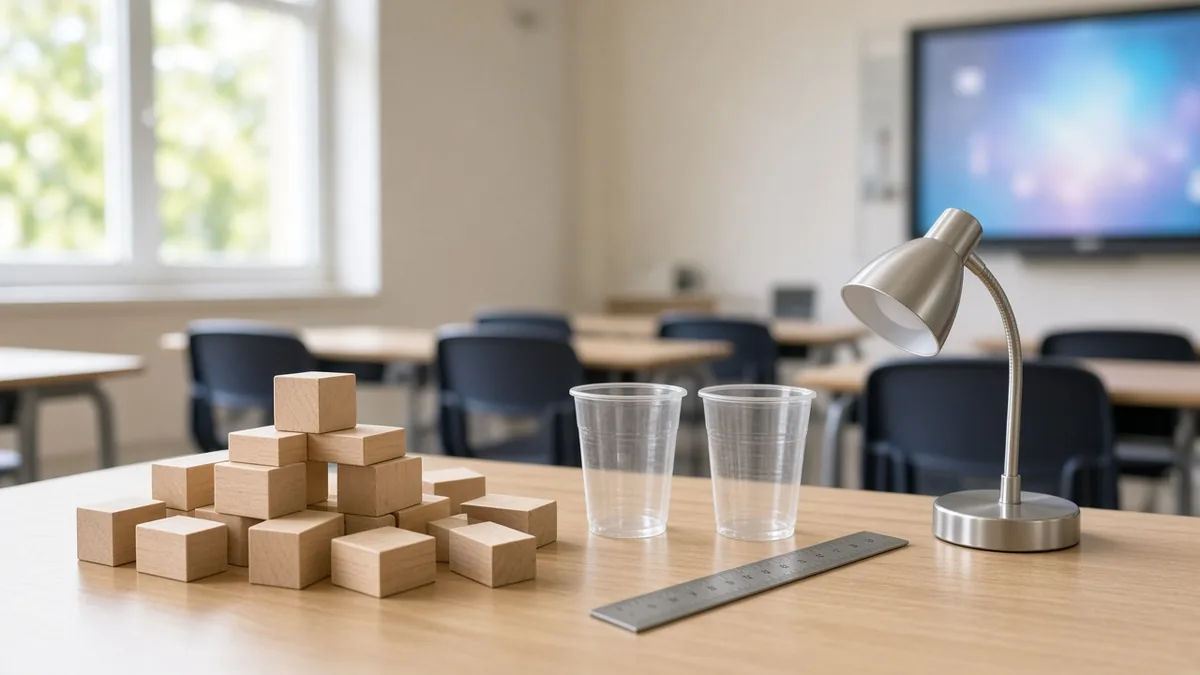
Classroom STEM activities do not have to mean a cart of kits or a special lab day. A lot of the work is a question, a timer and a way to show every group the same prompt. If you can project a board, you can run a predict-observe-explain cycle, a short design challenge or a class data set without reprinting a packet each time.
This list has 12 low-prep ideas you can run from MyClassScreen. They are not Halloween STEM, and they are not a replacement for our Hour of AI classroom activities plan, which is built for CSEdWeek. These are everyday science, tech, engineering and math routines you can use in a regular block.
How to set up a STEM board
Build one reusable layout and change only the prompt:
- A large question or challenge at the top
- A timer for the think, test or build window
- A space for a class prediction or a data tally
- A short "materials allowed" line so groups do not improvise a mess
- A close-out prompt: what we noticed, what we would change
Save the board and reuse it. The same frame can hold a sink-or-float question on Monday and a paper-tower challenge on Thursday. If you need groups in a hurry, the grouping tool will split the class without a debate at the front of the room.
Keep materials ordinary: paper, tape, cups, pennies, ice, a plant on the sill, yardsticks, or whatever you already have. The screen does the announcing. The table does the thinking.
12 classroom STEM activities
1. Predict, observe, explain
Put a single phenomenon on the board: an ice cube on a metal spoon vs a wooden one, a balloon near a wall, a plant leaning toward a window. Students write a prediction, you start a timer for the observation, then you collect explanations. The value is the three-part structure, not a flashy demo. Leave the three headings up so late arrivals can still join the cycle.
2. Ice-melt data table
Place ice on two or three surfaces and project a table: surface, starting time, minutes to melt, notes. A visible timer keeps the trial honest. At the end, ask what variable you actually changed and what you accidentally changed (room draft, cube size). This is a clean introduction to fair tests, and it uses winter weather instead of fighting it.
3. Estimation station
Project a jar, a stack of books, a length of hallway or a number of tiles in a photo. Students record a too-low guess, a too-high guess and a best estimate. Reveal the count, then talk about the strategies that got close. A second round with a new object shows whether the strategies improved. This is math, but it also trains the "range first" habit scientists use.
4. Noise-meter investigation
Your noise meter is already a science instrument. Post a question: which class routine is actually quieter, independent reading or a "silent" partner check? Run two timed samples, write the readings on the board, and discuss what the tool can and cannot tell you. It is a real data set, and it also improves the way you talk about volume later in the day.
5. Paper-tower or paper-bridge challenge
Show the brief and the constraints in large type: 20 minutes, ten sheets of paper, 30 cm of tape, the tower must stand on its own, or the bridge must span two desks. Use the timer, then a 2-minute gallery walk. End with one revision: what would you change if you had five more minutes? Engineering is the cycle, not the prettiest tower.
6. Longest-chain or farthest-flight challenge
The same board works for a paper-chain race or a paper-airplane distance test. Put the rules up so you are not restating them from the door. For flight tests, add a taped landing strip and a place to record distance. The math is measurement and spread; the engineering is design choices.
7. Unplugged algorithms
Project a grid or a simple map of the classroom. Students write a sequence of steps to get a "robot" (a classmate or a toy) from start to goal, then debug the path in front of the class. No devices required. This is computational thinking, and it is a good warm-up in the weeks around Hour of AI without repeating that lesson.
8. Class poll to graph
Ask a genuine question — how many books did you finish last month, how long is your walk to school, which seed do you want to plant — and tally the results live. Build a bar graph on the same board. Then ask one interpretation question: what would change this graph next month? You can leave the graph up during work time as a quiet reference.
9. Measurement scavenger
Project a list of measurements the class must find with rulers or meter sticks already in the room: something close to 15 cm, something close to a meter, two objects that add to 30 cm. A timer keeps it from drifting. Close with a quick check of the most surprising find. If you want a random order of teams, use the grouping tool rather than taking volunteers only.
10. Shadow and light track
On a sunny day, project a simple log: time, length of a pencil's shadow, direction. Take three readings in one period or one reading a day for a week. Students begin to connect the sun's position to a measurement they made, not a picture in a book. If the sun is not available, a flashlight and a still object will do for a single-period version.
11. Simple-machine hunt
Put six everyday classroom objects on the board (or label real ones): door closer, scissors, stapler, ramp for a cart, window blinds, bottle opener. Students classify the simple machine and name the force it helps with. A short timer per object keeps the pace up. This is engineering vocabulary with things they already touch.
12. Weather or seasonal observation board
Leave a week-long board up: date, temperature if you can get it, cloud sketch, one sentence about the schoolyard. Friday, look for a pattern. In mid-November this also gives you a calm, repeatable routine in a week that is already full of holiday noise. It does not replace your winter holiday classroom activities; it sits beside them as the science thread.
Tips that keep STEM activities calm
- Show the constraints before you hand out materials. Most messes start with an unstated rule.
- Use a visible timer for every build or trial. It is fairer than calling time from the back of the room.
- Collect one piece of class data on the board so the conversation is about evidence, not just opinions.
- Close with a revision question. That is the STEM habit you want them to take with them.
- For review days, you can still use classroom games after a short investigation, rather than turning the whole period into a quiz show.
A mid-year review station can be a lab recap or teach-back, rather than a new experiment.
If you teach older students, several of these scale up: tighter constraints, more data, a written claim with evidence. Our fun classroom activities for high school list has discussion formats you can attach to a design debrief. QR codes can send a group to a single instruction card without reprinting; see QR codes in the classroom.
A weekly STEM routine that does not take over the plan book
If a one-off challenge dies after Friday, build a light rotation instead of a new unit. One pattern that fits a 45-minute period is: Monday prediction or estimation (15 minutes), Wednesday a short trial or build (25 minutes), Friday a data look-back or revision (15 minutes). The same saved board can host all three days. You change the prompt line and the timer, not the furniture of the lesson.
Assign jobs the first week and keep them: materials, recorder, tester, reporter. A visible job list on the same board stops the same two students from doing all of the handling. If a group finishes early, do not invent a second project on the fly. Give them a revision constraint — half the tape, a taller load, a second trial — and let the original challenge go deeper.
Safety stays ordinary and specific. Ice melt means a towel. Towers mean no standing on chairs. Outdoor shadow walks mean a clear route and a time to be back. Put the one non-negotiable on the board next to the materials line so you are not shouting it over the timer.
Any of these tasks can become one of your learning centers in a weekly rotation.