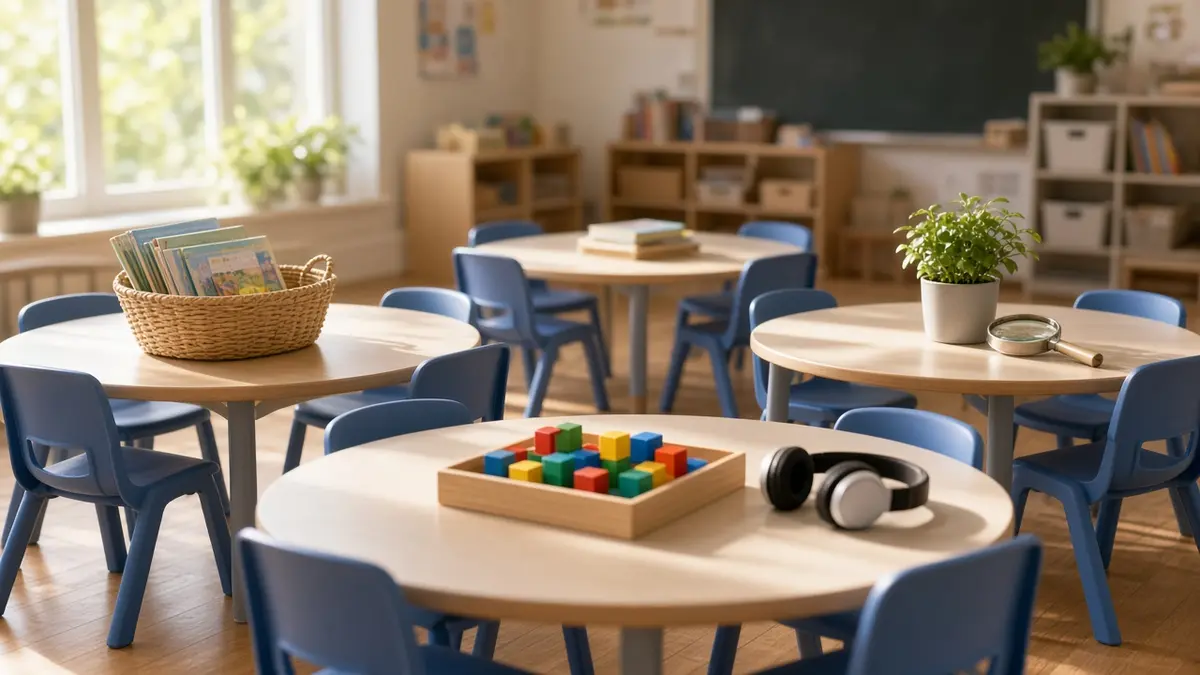
Classroom centers ideas work when the stations are simple and the rotation itself runs without you. The best centers have one clear task, materials already on the table, and a signal everyone can see when it is time to move. This guide gives you 20 station ideas for literacy, math and other subjects, a rotation plan you can copy, and a way to manage the timer, groups and noise level from one projected screen so you can stay at your teacher table.
If you already have stations and only need the timing, open the classroom timer and the group maker side by side on a live board. The rest of this page explains how to build centers that hold up week after week.
What classroom centers are (and what they are not)
A center, or station, is a spot in the room where a small group works on one task for a set time, then moves on. Every student visits several stations in a block, usually in a fixed order. One of those stations is often a teacher table where you work directly with a small group.
Centers are different from a few things they get confused with:
- A choice board lets students pick which task to do. Centers are assigned and timed. If you want the pick-your-own format, see our choice board ideas.
- Group work usually means one shared task for the whole class. Centers give each group a different task at the same time.
- Early-finisher tasks are optional extras. A center is a planned part of the lesson.
Keeping those lines clear helps you plan. A center needs a task that a group can start and finish without asking you how.
20 classroom centers ideas by subject
Each idea below is written as a station card: the task, what to put on the table, and how students show they finished. Pick four or five for one rotation, not all twenty.
Literacy centers ideas
- Read to self. A basket of leveled books and a short response slip: title, one sentence about the main idea.
- Listening station. Headphones and an audiobook or recorded read-aloud. Students sketch the setting or the problem when they finish.
- Word work. Letter tiles or magnetic letters with this week's spelling or phonics pattern. Students build, mix and rebuild five words.
- Sentence fix-up. Three sentences with mistakes on a card. Students rewrite them correctly on a whiteboard.
- Partner reading. Two copies of one short text. Partners take turns by paragraph and ask each other one question.
- Writing station. One prompt on a card and a timer. For ready-made stems, use our classroom writing prompts.
Math centers ideas
- Fact practice game. Dice or cards and a simple rule: roll two, add or multiply, record the number sentence.
- Hands-on build. Base-ten blocks or linking cubes with three numbers to build and draw.
- Measure it. Rulers and a tray of classroom objects. Students estimate, then measure and record the difference.
- Problem of the day. One word problem on the table, solved two ways.
- Sort and explain. Shape cards, fraction cards or number cards to sort into groups. Students write the rule they used.
- Math talk. A "which one doesn't belong" picture with four options. Students agree on an answer and give a reason.
Science, social studies and other centers
- Observation station. A plant, rock samples or a magnifier and a log sheet: draw it, describe it in three words.
- Map work. A simple map and three find-it questions.
- Sequencing cards. Life-cycle, historical-event or how-to steps cut up for students to put in order.
- Build and test. A small challenge with paper or cups (tallest tower, longest bridge). For more ideas in this style, see our classroom STEM activities.
- Art response. A picture or artwork with one question: what do you notice, what do you wonder.
- Vocabulary match. Word cards and definition cards to match, then use two in sentences.
- Review game. A quick board game or card game for a skill you taught last week.
- Teacher table. Your small group. Plan this one first and let the other stations support it.
How to set up a center rotation
The rotation is where most centers fall apart, not the tasks. A clear plan solves most of it.
Step 1: Decide the number of stations and the time
Fewer stations are easier to run. Many teachers start with four groups and four stations, then add a fifth later. Set the time per station to match your block: divide the total minutes by the number of stations, then leave a minute or two for each move. A shorter station that ends cleanly is better than a long one where groups finish early and drift.
Step 2: Make fair groups
Groups can be mixed-skill or matched to the teacher-table lesson. If you need random, balanced groups quickly, use the group maker; our guide on how to make random groups covers when to use random versus planned groups.
Step 3: Build a rotation chart
A rotation chart shows which group is at which station during each round. The simplest version is a grid:
| Round | Group 1 | Group 2 | Group 3 | Group 4 |
|---|---|---|---|---|
| 1 | Teacher table | Read to self | Word work | Math game |
| 2 | Math game | Teacher table | Read to self | Word work |
| 3 | Word work | Math game | Teacher table | Read to self |
| 4 | Read to self | Word work | Math game | Teacher table |
Each group moves one column to the right each round, so every group visits every station once. Project the chart so nobody has to ask where to go next.
Step 4: Teach the moves before the tasks
Before you run centers for real, practise the transition itself: stand, push in chairs, walk to the next station, sit, start. Our classroom transitions with timers guide has short routines you can rehearse in a few minutes.
Running classroom centers from one screen
A projected screen does three jobs during centers: it tells everyone how much time is left, where they go next, and how loud the room can be.
A visible timer for each round
Put the classroom timer in the corner of the board, large enough to read from every table. Start it at the beginning of each round. Students check the screen instead of asking you, which keeps the teacher table quiet. A one-minute warning before the end of a round gives groups time to tidy up.
The rotation chart on the board
Keep the rotation chart beside the timer. When the round ends, highlight the next row. A text widget is enough for a simple chart, and a saved template means you set it up once and reuse it every center day.
A noise and status signal
Centers are naturally louder than whole-class work. Decide what level is fine at each station and show it. The noise meter gives a live visual, and the traffic light works as a simple status signal: green for working, yellow for "check your voice level," red for "stop and look up." Our noise meter strategies post explains how to introduce it so it feels like feedback, not punishment.
Picking helpers and checkers
Many teachers name one "center captain" per group to collect materials and check the task card. A random name picker keeps that role fair across weeks, and you can rotate it like other classroom jobs.
Common center problems and quick fixes
Groups finish early. Add a short "if you finish" line to every station card, such as rereading, a second problem, or a sketch. Keep it at the same station so students do not wander.
Too much noise at one station. Move the loudest task, such as a game, away from your teacher table, or swap it for a quieter version on noisy days.
Students do not know what to do. Model each new station once with the whole class before it goes into the rotation. Keep task cards to three short steps.
Materials go missing. Use one labeled tub per station and make the center captain responsible for packing it before the move.
Transitions take too long. Time a practice transition and show the time on the screen. Students usually improve when they can see the number.
You get interrupted at the teacher table. Agree on an "ask three before me" rule and a visible signal for real problems, such as a card placed on the table.
Planning centers for a week
You do not need new stations every day. A steady pattern lets students learn the routine and spend their energy on the task.
- Keep the stations, change the content. Read to self stays read to self; the book basket changes.
- Introduce one new station at a time. Swap one center per week at most while the routine is new.
- Plan the teacher table first. Decide what each group needs from you, then choose independent stations that practise skills they can already do alone.
- Save the board. Keep the timer, rotation chart and signal on one saved layout. On center days you open it and press start.
If a substitute will run your centers, add the rotation chart and timer layout to your emergency sub plans so the routine stays the same while you are away.
Classroom centers by grade band
Centers look different across ages, even when the structure is the same.
- K-2: short stations, picture-based task cards, lots of hands-on materials and a very visible timer. Practise one transition at a time.
- Grades 3-5: longer stations, written task cards, and a simple recording sheet so you can check work later.
- Grades 6-8: stations often become "learning labs" with a reading, a problem set, a discussion prompt and a teacher check-in. Students can manage their own timer and rotation if the chart is on the screen.
The same board setup works at every level. Only the task cards change.